


Poverty is one of the most enduring global challenges, affecting billions across continents. Yet, despite its scale, the voices of the poor and marginalised often remain absent in mainstream debates.
Policymakers, experts, and media commentators frequently define the conversation, while those who live poverty daily stay silent.
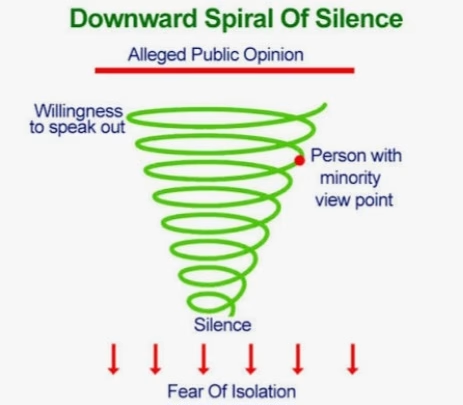
The Spiral of Silence Theory, proposed in 1974 by German political scientist Elisabeth Noelle-Neumann, helps explain this silence. Rooted in social psychology, the theory argues that individuals suppress their opinions when they believe these views are unpopular or contrary to the majority.
Fear of isolation drives this silence, and over time, dominant narratives overpower minority voices.
When applied to poverty, this theory provides a valuable lens to understand why stigma persists, why stereotypes dominate, and why structural inequalities often go unchallenged.
How the Spiral of Silence Shapes Poverty Narratives
1. Stigma and Shame
- Families conceal hunger and unemployment to avoid judgment.
- Silence perpetuates the myth that poverty results from laziness rather than systemic failure.
2. Media Representation
- Poverty is framed as charity rather than justice.
- Media tends to highlight stories of “escape” instead of focusing on systemic inequality.
3. Cultural and Social Exclusion
- Silence deepens when poverty intersects with social stigma like caste, gender, or ethnicity.
Evidence for the Spiral of Silence
South Africa: The Silence of Shack Dwellers
Despite being Africa’s most industrialised nation, inequality remains staggering. Residents of informal settlements like Durban’s Kennedy Road often suffer in silence, fearing retaliation if they protest against poor service delivery.
In 2021, the NGO Abahlali baseMjondolo reported that shack dwellers face harassment and even violence when they demand basic housing rights.
This reinforces Noelle-Neumann’s view: fear of isolation—or worse, repression—silences marginalized voices.
Zimbabwe: Poverty and Political Fear
In Zimbabwe, poverty debates are entangled with politics.
Citizens facing economic collapse often refrain from speaking openly about their struggles due to fear of state surveillance or being branded “unpatriotic.”
Here, the spiral is intensified not only by social stigma but also by political intimidation, which ensures poverty discourse remains muted in public spaces.
Ethiopia: Rural Hunger and Social Taboos
In Ethiopia’s rural communities, families facing food insecurity often avoid discussing hunger publicly.
Admitting poverty is equated with weakness and shame.
Local NGOs report that parents underplay their children’s malnutrition to maintain social dignity, leaving poverty unaddressed in communal decision-making.
Evidence Against the Spiral of Silence
Kenya: The Rise of Slum Dwellers’ Movements
Groups such as Muungano wa Wanavijiji (Federation of Slum Dwellers) challenge the theory’s assumption of silence.
Instead of withdrawing, they organise collective protests and demand housing reforms.
Their mobilisation shows that when safe platforms exist, marginalised voices can confront dominant narratives.
Nigeria: #EndSARS and Poverty Conversations
Although the #EndSARS protests began as a campaign against police brutality, they evolved into broader critiques of unemployment and inequality.
Youth in urban poor communities used digital platforms to bypass silence, making poverty a central issue in national debates.
This case challenges the notion that fear of isolation always prevents poor voices from surfacing.
Uganda: Digital Defiance
Ugandan activists have used platforms like Twitter to expose corruption and poverty.
Despite state crackdowns on digital freedoms, campaigns such as #ThisTaxMustGo (against social media tax) demonstrated that marginalised groups can resist silence and influence public debate.
Criticisms of the Spiral of Silence in Poverty Discourse
- Fluidity of Opinion
- In African contexts, public opinion shifts during crises. For example, droughts in Kenya or famine in Somalia temporarily shift poverty into mainstream political debate.
- Individual Differences
- Communities like South Africa’s shack dwellers’ unions prove that not all marginalised groups remain silent; some fight despite risks.
- Digital Media Counter-Spaces
- Social media in Africa—Twitter in Nigeria, WhatsApp in Zimbabwe, Facebook in Kenya—has provided counter-publics where the poor can share grievances and organize protests.
- Beyond Fear: Structural Exclusion
- Silence in African poverty contexts often arises not just from fear but from lack of platforms, weak institutions, or deliberate state repression. Poverty silence is enforced by structures, not only social stigma.
Breaking the Spiral of Silence
1. Amplifying Marginalised Voices
- Support community media initiatives such as local radio in rural Africa, where literacy barriers exclude many from digital debates.
2. Challenging Media Narratives
- Encourage African newsrooms to cover poverty with depth, not just charity appeals or elite voices.
3. Inclusive Policy-Making
- Governments should use participatory budgeting (as seen in parts of Kenya and South Africa) to include poor communities in decision-making.
4. Safe and Inclusive Spaces
- Protect grassroots organizations from state harassment, ensuring they can campaign without fear.
5. Public Education Campaigns
- Campaigns reframing poverty as structural—linking it to corruption, inequality, and lack of jobs—can reduce stigma and spark honest conversations.
From Silence to Action
The Spiral of Silence explains much about how poverty remains hidden in African societies.
Stigma, fear, and exclusionary public opinion climates suppress the voices of the marginalised.
PYet Africa also offers counter-examples: from Kenyan slum dwellers to Nigerian digital activists, marginalised groups are proving that silence can be broken.
The challenge is clear:
- Media must include poor voices in storytelling.
- Governments must create channels where marginalised citizens influence policy.
- Civil society must defend the right to speak out.
Poverty is not just a condition of lack—it is a condition of exclusion.
Breaking the spiral is therefore not only about economics, but about voice, dignity, and justice.