

Zimbabwe’s story is often told through dates and events. 1965. 1980. 2008. 2017. 2026.
But beneath these markers lies something more human and more enduring—the ordinary citizen’s search for a voice in how they are governed.
Before independence, that voice did not exist in any meaningful sense.
The colonial system was designed not just to govern the black majority, but to exclude it from governance altogether.
Political participation was reserved for a few, while the many laboured, paid taxes, and lived under laws they had no hand in shaping.
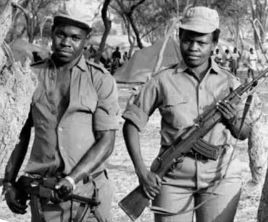
The liberation struggle emerged from this imbalance. It was not simply about land or national pride. It was about recognition.
It was about restoring the basic idea that those who live under authority must have a say in how that authority is formed.
When independence came in 1980, the introduction of universal suffrage was more than a procedural reform. It was a moral victory.
For the first time, the vote placed a rural farmer and an urban professional on equal footing.
In that moment, Zimbabwe attempted to correct a long-standing injustice by anchoring political power in the people.
Yet, as history unfolded, that relationship between the voter and power began to shift.
The 2008 elections stand as a turning point, not because Zimbabwe stopped voting, but because the experience of voting changed.
In many communities, particularly in rural areas, participation became associated with fear.
Reports from the Zimbabwe Election Support Network and the International Crisis Group highlight how intimidation, coercion, and violence reshaped the electoral environment.
For the ordinary citizen, the act of voting could no longer be separated from its consequences. It was no longer just a civic duty; it became a calculated risk.
This moment did not remove the vote, but it weakened the confidence that the vote could freely express the will of the people.
When fear enters the electoral process, the meaning of participation begins to erode.
Nearly a decade later, the events of 2017 introduced a different kind of shift.
The military intervention that led to the resignation of Robert Mugabe demonstrated that political power could change hands outside the immediate framework of elections.
While subsequent processes sought to restore electoral legitimacy, the sequence itself mattered.
For many citizens, this raised a quiet but important question: if leadership can change without the direct involvement of the voter, what then is the exact weight of the vote?
Analysts such as Stephen Chan have pointed out that 2017 did not eliminate elections, but it altered their place within the broader system of power.
The ballot remained, but it was no longer the only visible pathway through which leadership could be determined.
Now, in 2026, Zimbabwe is again confronted with a moment of structural reconsideration.
Constitutional amendments are being debated with the intention of refining governance.
On the surface, these are technical and legal adjustments. But at a deeper level, they raise questions about proximity—how close power remains to the people.
Legal interpretations from Veritas Zimbabwe suggest that some of the proposed changes may increase reliance on appointed roles and internal institutional processes.
While such measures may be justified in terms of efficiency or stability, they inevitably reshape how citizens relate to authority.
The concern is not that democracy is being removed. It is that it may be becoming more distant.
The principle of one man, one vote was never just about participation. It was about directness. It was about the assurance that the citizen’s choice has a clear and immediate impact on leadership.
When that chain becomes longer, moving through layers of representation and internal decision-making, the sense of ownership begins to weaken.
Political theorist Samuel Huntington warned that democracies often change not through dramatic breakdowns, but through gradual adjustments that alter how power is exercised while preserving the appearance of continuity.
Zimbabwe’s current moment reflects this kind of slow transformation.
It is important to state clearly that Zimbabwe is not on the brink of war.
The conditions that produced the Second Chimurenga are not present today.
Armed struggle is neither visible nor likely.
Regional frameworks such as the Southern African Development Community also act as stabilising forces.
However, stability should not be confused with satisfaction.
When citizens begin to feel that their participation carries less weight, the consequences appear in quieter forms—disengagement, scepticism, and a gradual withdrawal from public processes.
Over time, this affects not only politics but development itself, as governance becomes less responsive to the realities of everyday life.
Equally important is the question of process. The 2013 Constitution was built through consultation and affirmed by the people.
It carried legitimacy because citizens saw themselves in it. When changes of a similar magnitude are made without returning to the people, the risk is not only legal, it is relational.
The constitution begins to drift from being a shared national agreement to a document managed at a distance.
Zimbabwe’s journey from colonial exclusion, through liberation, through the electoral trauma of 2008, through the institutional shift of 2017, and now into constitutional reform, is ultimately a story about the location of power.
Where does it sit?
Who controls it?
How directly can the ordinary citizen influence it?
These are not abstract questions.
They shape how people live, how resources are distributed, and how justice is experienced.
The struggle for Zimbabwe has never been only about removing oppression.
It has always been about defining participation.
And that struggle has not ended.
It has simply changed its language.
No longer spoken through the gun, it is now spoken through laws, amendments, and institutional design. It is quieter, less visible, but no less significant.
If the liberation war brought the vote closer to the people, then the true test of this generation is whether its decisions will keep it there—or slowly move it away.