

Malaria has long been one of Africa’s deadliest public health challenges. Every year, hundreds of thousands of lives are cut short by this preventable and treatable disease, with young children and pregnant women being the most vulnerable.
Families across the continent know the heartbreak of losing loved ones to malaria — a reminder that the disease is not just a medical issue, but also a social and economic burden.
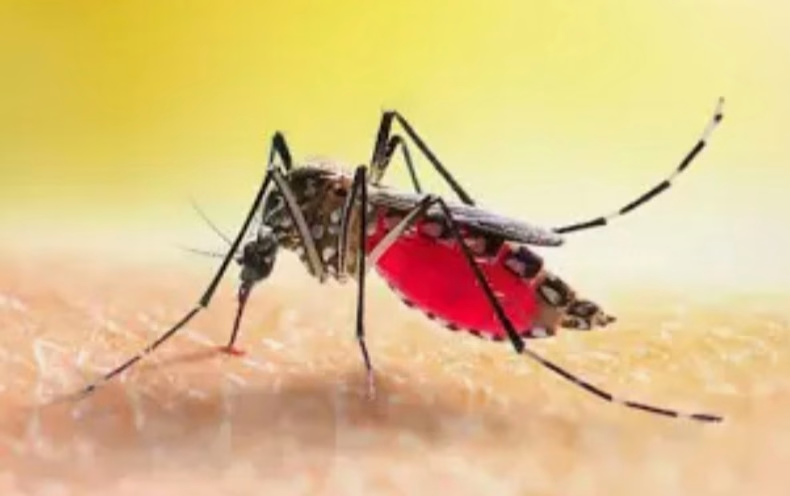
At its core, malaria is caused by parasites transmitted through the bite of an infected female Anopheles mosquito.
Once inside the body, the parasite attacks the liver before spreading to the blood, leading to fever, chills, and severe fatigue.
If left untreated, the infection can quickly escalate to seizures, organ failure, or even death.
For children who survive repeated bouts of malaria, long-term effects such as stunted growth and impaired learning remain an invisible cost.
A Heavy Toll on Africa
The World Health Organisation’s 2024 Malaria Report paints a sobering picture: an estimated 263 million malaria cases were recorded in 2023, with nearly 600,000 deaths worldwide.
Africa alone accounted for 94% of these cases and 95% of deaths. Alarmingly, three out of every four malaria-related deaths on the continent were children under five.
The reasons for Africa’s heavy burden are complex.
The warm, humid climate allows mosquitoes to thrive, while the deadliest malaria parasite, Plasmodium falciparum, is widespread across the region.
Poverty and limited access to healthcare further fuel the spread, leaving rural communities particularly exposed.
Many families cannot afford proper treatment or preventive measures, and myths or reliance on natural remedies such as using chili peppers to “cure” malaria — still circulate in some areas.
Drug resistance adds another challenge. Over time, parasites have learned to survive many of the medicines once used to treat malaria.
Poor-quality drugs and incomplete treatments make matters worse, threatening decades of progress.
The Role of Science in the Fight
Despite these challenges, science has been at the center of Africa’s battle against malaria, bringing both practical solutions and new hope.
- Better Medicines: The shift to artemisinin-based combination therapies (ACTs) has saved millions of lives. These drugs use two compounds that work together to clear parasites and reduce the risk of resistance. Research is now focused on developing new medicines that target the parasite at different stages of its life cycle.
- Improved Diagnosis: Rapid diagnostic tests, made possible through scientific advances, are now available even in remote clinics. These tests allow health workers to quickly confirm malaria cases and provide treatment before the disease worsens.
- Prevention Tools: Science gave the world insecticide-treated mosquito nets (ITNs) and indoor spraying programs, which remain cornerstones of malaria prevention. More recently, vaccines like RTS,S have been introduced, offering partial protection for children in high-risk areas.
- Innovative Research: Scientists are exploring bold solutions such as using gene-editing tools like CRISPR to alter mosquito populations, either by making them resistant to the parasite or reducing their ability to reproduce. Data science is also playing a role, with digital tools now used to track outbreaks and resistance patterns in real time.
Governments and Communities on the Frontline
Across Africa, governments are combining science with local action. Zimbabwe, for example, has changed its malaria treatment protocols over the years in response to resistance, ensuring patients receive the most effective drugs.
Countries are also investing in health education, distributing mosquito nets, and rolling out preventive treatments for pregnant women and infants.
But science alone is not enough. Community awareness, consistent funding, and strong health systems are equally important. Without them, scientific breakthroughs risk being out of reach for the very people who need them most.
A Glimpse of Hope
The fight against malaria is far from over, but the progress made in the past two decades proves that science can change the story.
Death rates have fallen significantly, and new tools continue to emerge. For families in malaria-endemic regions, each breakthrough is more than a statistic — it represents a chance at life, health, and a future free from the shadow of this disease.
As Africa continues its journey, science remains one of its strongest allies. With sustained investment, innovation, and community-driven action, the continent can look forward to a day when malaria is no longer a household threat but a defeated enemy.