

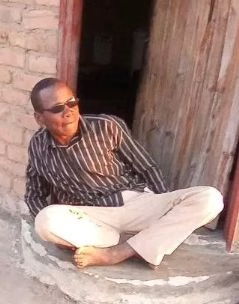
On the morning of September 3, 2015, Charles Bakuri did not know his life was about to split into two parts: the man he used to be, and the man he would struggle to become.
Born in 1979 at Masvingo General Hospital, Bakuri had grown up seeing the world clearly.
That morning, around 8 a.m., while doing his usual chores, something felt wrong. His right eye suddenly went dark.
“I tried to wash it with water,” he says quietly. “But I could only see black.”
Within hours, his left eye followed.
At first, the darkness was not total. He could still make out human shapes—moving outlines without identity.
He could not tell whether a person was a man or a woman, what they wore, or what expression they carried.
Then even that faded. Everything became black.
When Medicine Fails and Hope Becomes Fragile
Before his blindness, Bakuri had already endured personal loss.
He had separated from his wife and family, a family of two children who now live in Mutare, and a third who had since passed hiaway.
When his sight began to fail, he went to Norton Hospital, hoping for answers.
Specialists prescribed medication which he had to apply four times a day to the eyes.
He followed the instructions carefully.
But instead of healing, his world dimmed further.
“The more I used the medicine, the more I lost everything,” he says. “Even the outlines disappeared.”
Doctors could not explain what was happening.
They could not name the illness. They could not stop it.
One doctor, speaking privately, suggested something outside medicine: seek spiritual healing.
From Independence to Dependence
Bakuri followed that advice with the desperation of someone who had nothing left to lose.
He visited prophets – many of them, well-known ones—moving from place to place, holding on to the possibility of a miracle.
None came.
What came instead was a different kind of reality, dependence.
A man who once worked and lived independently now relied on strangers for food, for rent, for movement, for survival.
“From being independent, I started living on the goodwill of others,” he says. “Up to now, I am grateful to those who helped me.”
Church members assisted him.
Friends transported him from one place to another.
But help, however generous, was never permanent.
Between those moments of kindness were long stretches of vulnerability.
A Past Marked by Fear
Returning to his rural home was not an option he could easily embrace.
Raised as an orphan, Bakuri carries memories that still disturb him. One night, he slept outside with other children because of the heat in Masvingo.
As he lay there, he heard something move across his blanket.
A snake had entered.
“It moved on top of the sheets and rested on my pillow,” he says.
They killed it and left it behind the house to burn in the morning. But when he lay down again, it returned.
“I cried the whole night,” he remembers.
There were other unexplained moments too. One other time when he intended to go to South Africa in search of work, he once collapsed after seeing something he still cannot describe.
“I wanted to wake up and go and pass urine,” he says. “Then I saw things I cannot explain—and I blacked out.”
He was unconscious for three days. To only woke up at a church shrine.
When Blindness Meets Betrayal
After losing his sight, only two relatives visited him—and only once.
The rest of his survival came from people who were not family.
In 2018, he found hope again in marriage.
His new wife became his support system.
“She was my eyes,” he says. “She was everything.”
She cooked, cleaned, guided him—helped him exist in a world he could no longer see.
But in 2019, that trust broke.
His wife confessed she was in a relationship with his best friend—the very man who visited regularly, bringing food, meat, and groceries, checking if they needed sugar or anything else.
“She asked me not to beat her first,” Bakuri recalls. “Then she told me.”
The reason, she said, was a promise—something “big” the man had offered her.
“I never knew what it was,” Bakuri says.
He faced a kind of helplessness few people can imagine.
“Even if I wanted to react, how could I? I could not see her. She was my eyes.”
When he ended the relationship, the situation spiraled.
His wife allegedly drank poison and collapsed at the doorway. He could not see how it happened. Others carried her to Norton Hospital.
“I was told she had taken poison,” he says. “How could I know?”
Then came a chilling message from her relatives: if she died, he should “eat her corpse.”
Living in Fear, Staying in Need
She survived.
And they continued living together, not out of healing, but necessity.
“I was afraid she would kill herself,” he says. “And I needed her. I could not do without my eyes.”
But things worsened.
She started receiving calls from other men, left home in the evenings, returned late into the night.
Bakuri reached out for help, even calling radio personality Chikara Ndundu for counselling.
He was counselled over the phone.
Still, the situation collapsed.
In 2022, she left—taking everything that remained.
The Lowest Point
What followed was not just poverty. It was abandonment.
One morning, a boy from the neighborhood walked into his room and found him eating leftover sadza.The boy grabbed the plate.
“He asked me why I was eating that,” Bakuri says.
The food was infested with cockroaches.
“He was shocked I did not know.”
There was no one to cook. No one to clean. No one to check if he was alive.
He thought about ending his life.
“But how?” he asks. “I could not see a rope. I could not see a beam.”
A Glimpse of Light
After five years of total blindness, something unexpected happened.
One morning, he woke up and saw the asbestos roof.
Then the faint shine of a door handle.
He stood up, walked toward it, opened the door—and was overwhelmed by light.
He fell.
Outside, people gathered.
Neighbors, strangers and those who had quietly supported him celebrated.
For a moment, it felt like restoration.
But it did not last.
“My sight came back, but not fully,” he says. “And slowly, it started going again.”
A Life Reduced to Begging
Today, Bakuri can move on his own, but his vision is limited. At night, he is completely blind.
He can type on his phone, but cannot see beyond arm’s length.
What pains him most is not just the condition but what it has made him become.
“My life is now about begging,” he says. “For food. For toilet paper. For airtime. For clothes. Even for undergarments.”
He pauses.
“When I wake up, I think about where to beg. When I sleep, I think about how to beg better.”
Then he adds, almost in a whisper, “That is not human.”
Wandering Without a Home
When he could no longer pay rent with four months in arrears, he locked the door and left.
He had nowhere to go.
He wandered until he reached Kuwadzana 6.
Around Guzzlers Night Club became his resting place—not inside, but outside, in its surroundings.
During the day, he walked aimlessly sometimes he could reach Budiriro and other time up to National Sports Stadium—returning before dark like someone going “home.”
Vendors began to recognise him.
That time, he went for 21 days without bathing. Without changing clothes.
He later moved again—briefly to a shrine, then to Zvimba after promises of work that never came.
Now, he is near Lions Den, in the Chinhoyi area.
Still uncertain. Still dependent.
A Simple Request, A Quiet Faith
Bakuri does not ask for much.
“I do not have money to start a business,” he says. “I do not have a place to stay.”
What he wants is simple and profound.
“If I can just have a place to stay, it would make a difference. Looking for food is easier when you have somewhere to return to.”
Through everything—the darkness, betrayal, hunger, humiliation—one thing has not left him.
Faith.
“I never lose faith in my Lord,” he says. “I believe I will serve Him more.”
Charles Bakuri’s story is not loud. It does not demand attention. It simply sits with you—heavy, human, unresolved.
And perhaps the question it leaves behind is not what happened to him.
But what happens next—and who, if anyone, will step in to change it.
You can contact Bakuri on his cell number: 078 262 3330