


In an age driven by algorithms, marketing strategies, branding consultants, and sponsored advertisements, it is almost unimaginable to gather thousands of people without publicity.
Today, major events require months of planning, digital campaigns, ticketing systems, and professional sound engineering.
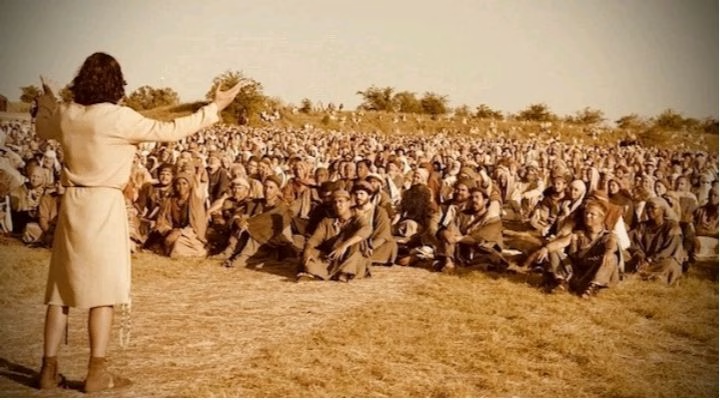
Yet over two thousand years ago, in the hills and shores of Galilee, Jesus Christ gathered multitudes in numbers that still astonish historians and theologians alike.
No posters.
No social media.
No microphones.
No amplifiers.
And yet — thousands came.
This is not merely a historical curiosity. It is a profound revelation of the power of the Gospel.
LARGE NUMBERS AT THE SEASHORE
The Gospel account in Gospel of Matthew records, “And great multitudes were gathered together to Him, so that He got into a boat and sat; and the whole multitude stood on the shore.” (Matthew 13:2, NKJV)
The phrase “great multitudes” indicates large, pressing crowds — so large that Jesus had to enter a boat to create space between Himself and the people.
Similarly, Gospel of Mark states that, “And a great multitude was gathered to Him…” (Mark 4:1, NKJV)
And in Gospel of Luke, we read, “The multitude pressed about Him to hear the word of God.” (Luke 5:1, NKJV)
These were not small village meetings.
These were overwhelming gatherings.
The emphasis in Scripture is clear, large numbers consistently followed Jesus.
THE FEEDING OF 5,000 — NUMBERS THAT DEFY LOGIC
One of the most dramatic examples appears in Matthew 14.
“Now those who had eaten were about five thousand men, besides women and children.” (Matthew 14:21, NKJV)
Five thousand men.
The text specifically notes that this count excludes women and children. Conservative estimates suggest the actual crowd could have reached 15,000 to 20,000 people.
To put this into perspective:
That is the size of a modern sports arena.
That is a massive, unorganised, open-air gathering.
And this occurred in a remote place.
What drew such a crowd?
The Gospel says, “He was moved with compassion for them, and healed their sick.” (Matthew 14:14, NKJV)
Healing drew the hurting. Authority drew the curious. Compassion drew the desperate.
The result? Large numbers.
THE FEEDING OF 4,000 — AGAIN
In Matthew 15, history repeats itself.
“Now those who ate were four thousand men, besides women and children.” (Matthew 15:38, NKJV)
Again, the number excludes women and children. Once more, the true figure likely exceeded 10,000 people.
What is remarkable is not only the miracle of multiplication; seven loaves and a few small fish feeding thousands, but the scale of attendance.
Verse 30 states:
“Then great multitudes came to Him, having with them the lame, blind, mute, maimed, and many others…”
These were not casual attendees. They brought the sick, the disabled, the desperate.
Entire communities mobilised.
The emphasis is unmistakable, large numbers consistently responded to Jesus.
WHY SUCH LARGE NUMBERS?
In modern analysis, large crowds are usually attributed to:
Marketing
Celebrity
Political influence
Economic incentives
Entertainment value
But in first-century Galilee, none of these factors applied.
Jesus had:
No political office
No military backing
No financial empire
No institutional endorsement
Yet Gospel of Matthew 4:24 states, “Then His fame went throughout all Syria…”
Fame spread organically by testimony.
The healed told their families.
The delivered told their towns. The witnesses told neighboring villages.
Large numbers were drawn by transformed lives.
AUTHORITY THAT ATTRACTED THE MASSES
Another reason for these large gatherings is recorded in Matthew 7; “For He taught them as one having authority, and not as the scribes.” (Matthew 7:29, NKJV)
Authority attracts attention.
Religious leaders of the day often relied on tradition and commentary.
Jesus spoke directly, decisively, and powerfully.
When He spoke:
Storms ceased.
Demons fled.
The sick recovered.
The dead were raised.
Large numbers followed because something unprecedented was happening.
THE GEOGRAPHY OF GALILEE
The region around the Sea of Galilee contained numerous towns within walking distance of one another.
News traveled quickly through marketplaces, synagogues, and fishing communities.
But geography alone does not produce thousands.
What transformed rumor into massive gatherings was demonstration.
Miracles multiplied attendance. Compassion sustained it. Truth deepened it.
LARGE NUMBERS WITHOUT MANIPULATION
Most striking is what Jesus did not do.
He did not soften His message to maintain crowds. He did not promise material gain to secure loyalty. He did not measure success by attendance.
In fact, in John 6, after a large miracle, many disciples withdrew when His teaching became challenging.
Yet even when some left, others gathered elsewhere.
Why?
Because the Gospel itself carries drawing power.
A PATTERN THAT CONTINUED
The pattern of large numbers did not end with Jesus’ earthly ministry.
In the Book of Acts, we read:
“And believers were increasingly added to the Lord, multitudes of both men and women.” (Acts 5:14, NKJV)
Again multitudes.
No church buildings. No marketing strategy. No political protection.
Only the power of the Holy Spirit.
The large numbers of gatherings in the New Testament is not accidental.
It demonstrates that when divine authority meets human need, response follows.
LARGE NUMBERS THEN — LESSONS NOW
Today’s world is skeptical. It demands proof, authenticity, and credibility. Yet the Gospel accounts show that large numbers gathered not because of spectacle, but because of substance.
What drew thousands in the first century?
The Word of God demonstrated compassion, visible transformation could be seen.
Spiritual authority and miraculous power also drew people.
The feeding of 5,000. The feeding of 4,000. The multitudes at the shore. The pressing crowds in Galilee.
These were not minor gatherings.
They were massive, undeniable movements.
WHEN POWER REPLACES PROMOTION
The emphasis on large numbers in the Gospel narratives highlights a timeless truth; When truth is spoken with authority and compassion, people respond.
Jesus did not rely on amplification systems. The sea became His soundstage. The hills became His auditorium. Creation itself carried His voice.
The Gospel message spread across regions and borders without advertising campaigns, because transformed lives became living announcements.
Large numbers were not the goal. They were the result.
And history still records those astonishing gatherings along the shores of Galilee, where thousands stood listening to a Teacher in a small boat, proving that when heaven moves, numbers follow.
The Gospel was never small.
From the very beginning, it reached multitudes.