


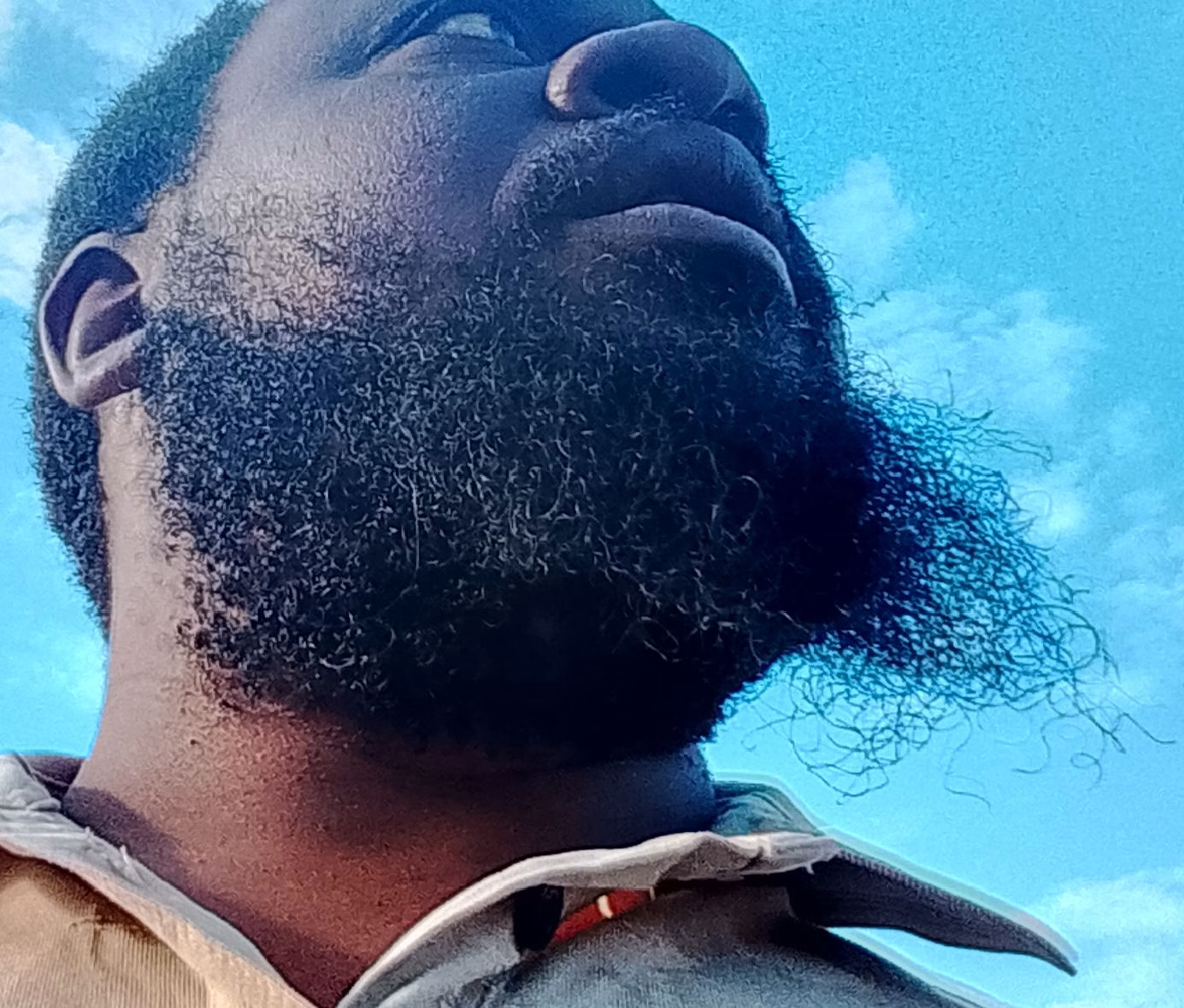
In the Zimbabwean imagination, an unkempt beard can become shorthand for a man’s economic standing. In everyday conversation, the beard is not just hair; it is biography.
It is assumed to narrate struggle, neglect, even failure. Yet this symbolism is neither natural nor neutral.
The Beard as Social Text
Zimbabwe’s urban centers, especially in cities like Harare and Bulawayo—a trimmed beard has increasingly come to signify care, disposable income, and cosmopolitan polish.
The clean lines shaped in barbershops in Avondale or Budiriro are associated with executive culture, Pentecostal pastors, and corporate ambition.
Clean-shaven faces, meanwhile, are often read as “professional,” suitable for banking halls, government offices, and NGO boardrooms.
An unkempt beard, by contrast, is frequently interpreted as evidence of economic precarity.
It suggests a man who cannot afford regular grooming, who has fallen through the cracks of formality, who inhabits the margins.
In high-density suburbs like Mbare or Makokoba, such assumptions can determine how one is treated by everyone be it employers, police officers, even church ushers.
The beard becomes what sociologists call a “visible marker,” a symbol through which poverty is aestheticised and judged.
Apostolic Beards: Faith or Poverty?
This stereotype sharpens when viewed through the lens of Zimbabwe’s religious landscape.
Members of the Johane Marange Apostolic Church and other apostolic sects are often recognised by their white garments and, in many cases, long, untrimmed beards.
To outsiders, especially urban elites, this appearance is frequently conflated with backwardness or poverty.
But within the sect, the beard carries theological weight.
It symbolises separation from worldly vanity, obedience to scripture, and spiritual humility.
The beard is not neglect, it is devotion. It reflects an ascetic ideal, a renunciation of excessive self-adornment.
For many adherents, the untrimmed beard is a covenant, not a consequence of poverty.
Yet perception rarely pauses for nuance.
In public discourse, apostolic communities are often described as the poorest of the poor—economically marginalised, educationally disadvantaged, socially isolated.
While it is true that many apostolic sect members live in rural areas and informal settlements, poverty is not a doctrine of the church.
There are prosperous apostolic businesspeople, farmers, and cross-border traders.
Still, the image persists: beard equals poverty; poverty equals apostolic.
This reduction is one of the “vulgarities” of poverty—the crude simplification of complex lives into aesthetic stereotypes.
Pentecostal Polish and the Gospel of Presentation
Contrast this with the polished image of many Pentecostal congregations, such as ZAOGA Forward in Faith or United Family International Church.
Here, presentation is often intertwined with theology.
Prosperity preaching emphasizes upward mobility, divine favor manifested through material success.
Pastors appear in tailored suits; congregants are encouraged to “dress for their breakthrough.”
In these spaces, the trimmed beard or clean shave becomes a signifier of alignment with modernity and aspiration.
Grooming is testimony.
The body becomes evidence of faith’s rewards.
The contrast is stark: one beard is read as spiritual humility; the other as social negligence.
One shave is read as professionalism; another as worldliness.
The Poor Man’s Face
For the poor man navigating Zimbabwe’s fragile economy, these symbols can be burdensome.
Tendai Kanengoni (not real name), a 32-year-old informal mechanic in Epworth, says he keeps his beard short not because he prefers it, but because “people respect you more when you look neat.”
A trim costs money he sometimes does not have.
When business is slow, his beard grows not out of principle, but out of necessity.
He notices the difference in how customers speak to him.
“The beard starts speaking before you do,” he says.
This is the quiet violence of aesthetic judgment.
Poverty becomes visible not only in torn fabric but in uncut hair.
The stigma attaches itself to the body. Sociologists might call this “embodied marginality”, where structural inequality is read as personal failure.
The tragedy is that poverty is structural: shaped by unemployment rates, currency instability, and shrinking industries.
Yet it is interpreted cosmetically.
Are the Apostolic Poor?
To ask whether apostolic sects are poor is to ask the wrong question.
Poverty is not a theology; it is a condition shaped by land distribution, access to education, and national economic policy.
Many apostolic communities emphasise self-reliance, communal support, and informal enterprise. Some members are indeed economically vulnerable; others are not.
What persists, however, is the narrative that their unkempt beards and simple garments are evidence of destitution rather than doctrine.
Here, symbolism overrides sociology.
Beyond the Beard
If we are to champion the voice of the poor, we must resist turning poverty into an aesthetic category.
The poor should not have to perform respectability to deserve dignity.
Nor should they be reduced to visual cues that make the comfortable feel superior.
To present the poor without symbolising their poverty requires shifting focus:- From appearance to agency.
From grooming to governance.
From stereotypes to stories.
It means recognising that a beard trimmed, untrimmed, or absent is not an economic report.
It means listening to lived realities rather than reading surfaces.
In the end, the “vulgarities of poverty” are not the beards themselves, but the cruel assumptions attached to them.
Poverty is vulgar not because it is visible, but because society insists on misreading it.
The beard grows. The economy contracts. The judgments linger.
And somewhere in Harare, a man strokes his chin before a job interview, wondering whether to spend his last dollar on a shave—not for hygiene, not for faith, but for the hope that, this time, his face will not betray him.