

This script examines the common business practice of acquiring used industrial machinery as a cost-saving measure. While the initial purchase price is a low and attractive figure, it often obscures the complete financial picture.
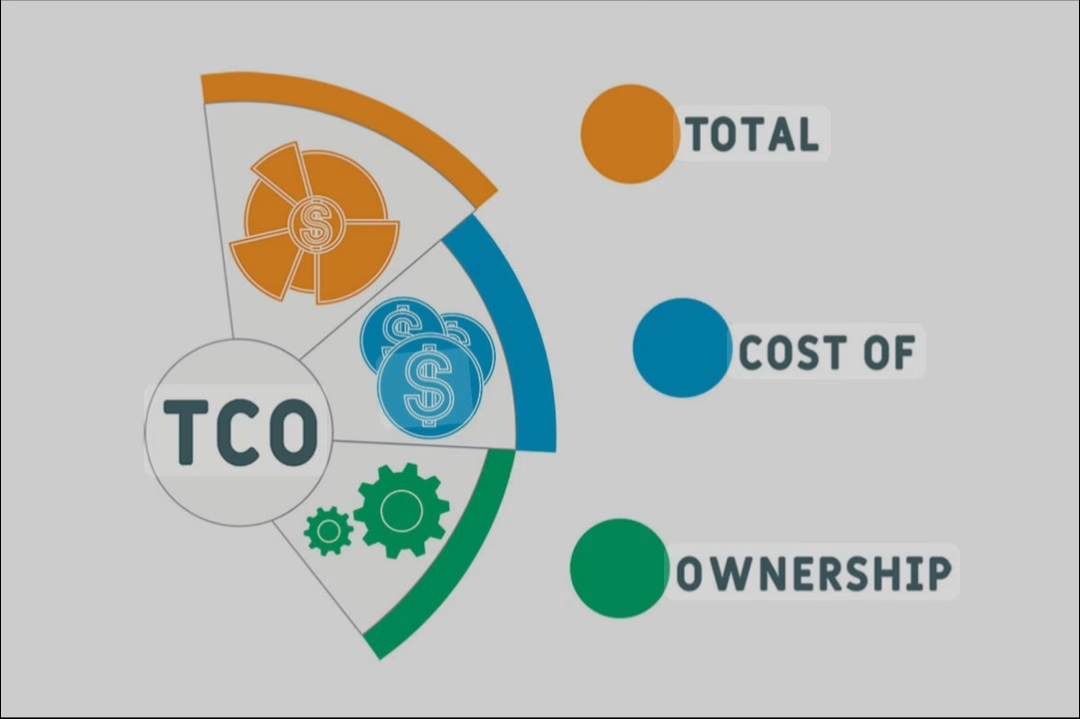
This analysis introduces the concept of Total Cost of Ownership (TCO), a metric that accounts for all direct and indirect expenses over a machine’s lifecycle.
My findings indicate that a narrow focus on the purchase price can lead to significant, unforeseen costs related to downtime, maintenance, and reduced efficiency. I therefore assert that a thorough TCO analysis is essential for anyone considering buying used equipment to ensure long-term operational and financial viability.
The Flaw in the Initial Cost Assessment
In developing economies, the strategy of purchasing used industrial machinery is widespread. The logic is simple: acquire a functional asset at a fraction of the cost of a new one to save capital for other business needs. This perspective, however, treats the machine as a static asset, much like a piece of furniture. In reality, industrial equipment is a dynamic system that requires continuous investment to remain productive.
The initial purchase price represents a single, one-time transaction. It fails to account for ongoing operational costs, which can escalate dramatically over time, particularly for older equipment. This oversight can create a false sense of security and lead to financial surprises down the road.
Defining Total Cost of Ownership (TCO)
Total Cost of Ownership (TCO) is a comprehensive financial model used to calculate all direct and indirect costs associated with an asset over its lifespan. For industrial machinery, TCO extends beyond the purchase price to include:
- Acquisition Costs: The initial price of the machine, shipping, and installation. This is normally considered part of the purchase price.
- Operational Costs: Energy consumption, consumables, and labour.
- Maintenance & Repair Costs: The price of spare parts, labour for repairs, and emergency service calls.
- Downtime Costs: The value of lost production, including lost revenue and idle labour costs.
- Efficiency Costs: The financial impact of a machine running slower or less reliably than a modern alternative.
For used machinery, the latter three categories—maintenance, downtime, and inefficiency—tend to be disproportionately high.
Key Components of TCO in Used Machinery
The Financial Impact of Unplanned Downtime
A machine is only profitable when it is running. Unplanned downtime, or a breakdown that stops production, is a hidden but significant cost. For a used machine, these failures are often more frequent and unpredictable. The costs associated with downtime include:
- Lost Revenue: The direct financial loss from not producing goods or services.
- Labour Costs: Paying operators and support staff for idle time.
- Overhead Costs: The continuation of fixed costs such as rent and utilities, even when production has stopped.
A single day of unplanned downtime can easily erase the initial cost savings of a used machine.
The High Price of Obsolete Spares
Older machines rely on parts that are no longer in production by the original manufacturer. When a component fails, the process of finding a replacement is fraught with challenges.
- Extended Lead Times: Locating a spare part can take weeks or even months, leading to prolonged downtime.
- Inflated Costs: The scarcity of these parts drives up their prices on the secondary market.
- Risk of Counterfeits: The buyer faces the risk of acquiring a non-genuine or low-quality part.
This analysis indicates that the cost of an obsolete spare part can be several times higher than that of a comparable new part, not including the cost of lost production while waiting for it to arrive.
Inefficiency and Lost Production
The operational efficiency of older equipment often falls short of modern standards. This is not just about a machine being “slow.” It encompasses a range of issues:
- Lower Production Speeds: The machine simply cannot process materials as quickly as its newer counterparts.
- Increased Scrap Rate: Older systems can be less precise, leading to a higher rate of defective products or waste that must be discarded.
- Higher Energy Consumption: Outdated technology is often less energy-efficient, driving up utility bills.
Over a machine’s lifespan, these seemingly small inefficiencies accumulate into substantial financial losses that are not reflected in the initial purchase price.
A Call for a Holistic Perspective
Conclusively, the decision to purchase used industrial equipment should be based on a comprehensive TCO analysis, not just the upfront purchase price.
While the initial savings may appear attractive, the cumulative costs of frequent breakdowns, expensive spares, and reduced operational efficiency can quickly erode those benefits.
Enterprises that embrace a TCO-based approach will be better equipped to make sound, long-term investments.
By asking critical questions about a machine’s expected lifespan, its maintenance history, and the availability of spare parts, decision-makers can move beyond the surface-level cost and make choices that truly support profitability and growth.
For further insights into the factors that influence machinery performance and cost, we invite you to join us next week as we investigate the foundational element of any automated system: the control system itself.
[…] By improving reliability, you also drastically cut down on the unpredictable costs of emergency repairs and sourcing obsolete spares, directly impacting the Total Cost of Ownership (TCO) https://tsikdem.co.zw/the-hidden-cost-of-old-machinery-more-than-just-the-purchase-price/. […]