

For the past few weeks, I deliberately took a sabbatical from writing and social media.
In an age where opinions move faster than contemplation, silence itself became a spiritual discipline.
Dear reader, once in a while, silence from the noise of this world is a prerequisite mainly for focus, refocusing or calibration. Unfortunately this is a topic for another encounter.
During that period, I immersed myself in theological reflections and the broader spiritual works within Christianity.
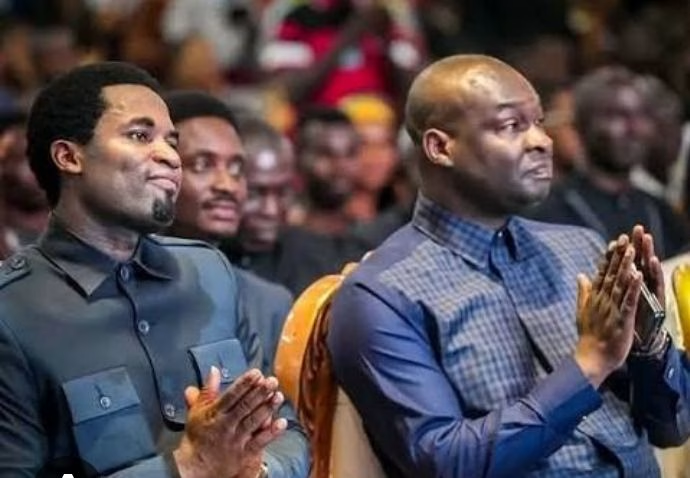
Among the voices that profoundly captured my attention were two Nigerian preachers whose influence continues to spread across Africa and beyond these are Apostle Michael Orokpo (PhD) and Apostle Joshua Selman.
The two are not the Alpha and Omega of Christianity, neither are they beyond criticism or theological scrutiny but they just fall under the scope of the article that I am currently penning.
Christianity existed before them and will continue long after them.
Yet there is something intellectually provocative and spiritually unsettling about their message.
Their teachings force one to confront uncomfortable questions about the state of modern Christianity, particularly the issue of spiritual stagnation within the church.
At the center of their teachings lies a recurring concern: why has Christianity in many places become dormant rather than transformative?
The Crisis of Dormant Christianity
One of the greatest paradoxes in modern Christianity is that millions profess faith, yet comparatively few appear transformed by it.
Churches are full, conferences are overflowing, and social media is saturated with religious content, but in practice spiritual maturity often remains scarce.
The Apostle Paul confronted a similar dialema in Hebrews 5:12:
“For though by this time you ought to be teachers, you need someone to teach you again the first principles of the oracles of God.”
This scripture captures the frustration of prolonged spiritual infancy.
Many believers remain dependent for decades, unable to progress into deeper dimensions of wisdom, discernment, spiritual authority, and kingdom responsibility.
Christians of more than 20 years of devotion to Christ, cannot graduate above praying for bread into other realms like casting out demons.
This is the issue both Nigerian preachers consistently challenge.
Their argument is simple but uncomfortable: Christianity was never designed to produce perpetual spiritual children.
It was meant to produce transformation.
The Intellectual Dimension of Faith
What fascinated me most was not merely their eloquence or charisma, (it fascinates) but the intellectual seriousness they bring into spiritual discourse.
Apostle Orokpo is academically trained in Chemistry, with studies linked to Pure and Physical Chemistry.
His scientific orientation appears to influence the analytical manner in which he approaches scripture, consecration, prayer, and spiritual realities.
Listening to his teachings, one notices structure, philosophical reasoning, and an attempt to explain spiritual systems with depth rather than emotional sensationalism alone.
Similarly, Apostle Selman studied Chemical Engineering at Ahmadu Bello University in Nigeria before becoming one of Africa’s most influential contemporary Christian teachers through Eternity Network International (ENI), popularly known as Koinonia Global.
His teachings often merge theology, leadership, spiritual intelligence, discipline, purpose, and kingdom influence.
In many African contexts, faith is often wrongly separated from intellectual inquiry.
Some people assume spirituality thrives only where critical thinking dies.
Yet historically, Christianity itself built universities, inspired philosophers, shaped civilisations, and influenced scientific inquiry.
Men such as Augustine, Thomas Aquinas, Blaise Pascal, and Isaac Newton never viewed faith and intellect as enemies.
Perhaps this explains why these Nigerian voices resonate strongly among students, academics, professionals, and young Africans searching for meaning beyond material survival.
Christianity as Transformation, Not Ritual
One of the strongest themes emerging from their teachings is the insistence that Christianity must produce visible transformation.
Romans 8:19 declares:
“For the earnest expectation off the creature waiteth for the manifestation of the sons of God.”
The emphasis is manifestation. Evidence. Growth. Spiritual evolution.
According to their teachings, Christianity is not merely about attending church services every week while remaining spiritually powerless, morally unstable, emotionally broken, and intellectually shallow. It is about becoming.
Many Christians besides many years committed to Christ can not even heal their children from influenza through prayer. They are preoccupied with church doctrines to the extent of missing the mark.
This idea is rooted in the ministry of Jesus Christ Himself.
Christ healed the sick, raised the dead, transformed lives, discerned thoughts, demonstrated authority, and transferred spiritual power to His disciples.
In John 14:12, Jesus made a statement that remains revolutionary:
“He that believeth on me, the works that I do shall he do also; and greater works than these shall he do.”
For both preachers, this scripture is not poetic symbolism alone. It is an invitation for believers to mature into spiritual effectiveness and kingdom responsibility.
Why Do Christians Rarely “Graduate”?
One of the most provocative questions raised in these teachings concerns spiritual progression.
In education, students graduate into professionals. A medical student eventually becomes a doctor.
A law student becomes an advocate. An engineering student becomes an engineer.
Every discipline expects growth, mastery, and competence.
Yet in Christianity, many remain at the same spiritual level for decades.

This concern mirrors Paul’s rebuke in 1 Corinthians 3:1-2, where believers could not handle “solid food” because they remained spiritually immature.
The argument advanced by these Nigerian teachers is that the church must restore discipleship, mentorship, consecration, prayer culture, revelation knowledge, spiritual discipline, and experiential Christianity.
The church should not merely produce attendees; it should produce mature believers capable of influencing society spiritually, morally, intellectually, and socially.
Beyond Prosperity and Personality-Centered Christianity
Another striking dimension in the teachings of and is the manner in which they present Christianity itself.
In an era where some modern ministries have increasingly reduced faith to material success, wealth accumulation, celebrity culture, and dependence on external spiritual objects, the two Nigerians appear to emphasise something deeper: the making of a complete and spiritually mature believer.

Their delivery, despite their growing global influence, often carries an unusual sense of humility, calmness, and introspection rather than theatrical self-exaltation.
One notices less obsession with building personality cults and more emphasis on personal consecration, discipline, scripture, prayer, and intimacy with God.
Perhaps what also makes their message compelling is that they appear to move Christianity away from dependency syndrome and toward spiritual responsibility.
In many religious environments today, believers can become perpetually attached to apostles, pastors, anointing oils, wrist bands, mantles, holy water, stickers, and symbolic spiritual objects as substitutes for genuine spiritual maturity.
Faith risks becoming transactional rather than transformational.
Yet the underlying message emerging from these Nigerian teachers appears different.
They consistently stress that the ultimate goal of Christianity is not merely to create materially successful people or emotionally excited congregants, but to form believers whose entire lives reflect the character, wisdom, discipline, humility, love, and authority of Christ.
In this sense, Christianity becomes holistic rather than transactional.
The believer is encouraged to grow intellectually, spiritually, morally, emotionally, and socially.
Prayer is not merely for miracles alone, but for transformation.
Scripture is not merely for quoting during hardship, but for shaping consciousness and character.
Spiritual authority is not presented as magical performance, but as the outcome of consecration, obedience, discipline, and intimacy with God.
They present a Christianity that challenges dependency within the church.
A Christianity where believers are not perpetually tied to personalities, but are gradually equipped to stand spiritually mature on their own foundations in Christ.
In many ways, this approach mirrors the Apostle Paul’s desire in Ephesians 4:13:
“Till we all come in the unity of the faith, and of the knowledge of the Son of God, unto a perfect man, unto the measure of the stature of the fullness of Christ.”
The emphasis is maturity. Completeness. Wholeness.
Not merely crowds.
Not merely church attendance.
Not merely prophetic excitement.
Not merely material success.
But transformed lives capable of reflecting Christ independently, responsibly, and meaningfully within society.
The Supernatural and African Spiritual Consciousness
Another major feature in their teachings is the unapologetic emphasis on the supernatural.
African societies already possess deep consciousness of spiritual realities.
Traditional religions, ancestral systems, prophetic traditions, and even occult narratives all reflect a continent that acknowledges the unseen realm.
The question therefore becomes: if other belief systems claim spiritual experiences and manifestations, why should Christianity appear powerless?
Both preachers frequently return to scriptures such as Mark 16:17:
“And these signs shall follow them that believe…”
Their teachings challenge a form of Christianity that is purely ceremonial and intellectually empty but devoid of spiritual conviction, authority, and transformative power.
However, this conversation also demands caution.
Africa has witnessed painful abuse through manipulative prophets, commercialisation of miracles, exploitation of vulnerable congregants, and dangerous personality cults masquerading as spirituality.
Therefore, any emphasis on supernatural Christianity must remain grounded in scripture, humility, accountability, ethics, and Christ-centeredness.
Power without character becomes dangerous.
Rediscovering Apostolic Christianity
What fascinates me most is that these teachings are, in many ways, an attempt to recover apostolic Christianity.
The early church was transformational.
The apostles carried conviction, sacrifice, revelation, discipline, doctrine, miracles, courage, and intellectual depth.
Christianity was not merely ceremonial; it shaped communities, ethics, economies, leadership, and civilisations.
Perhaps this explains why these Nigerian voices continue attracting followers across denominations, professions, and national borders.
They are responding to a generation hungry for a faith that is alive rather than dormant.
A faith that transforms rather than merely entertains.
Christianity Must Become Transformative Again
My withdrawal from writing unexpectedly became a period of introspection (not the crux of the epistle).
Listening to these teachings forced me to reflect deeply on faith, growth, discipline, revelation, purpose, and spiritual maturity.
Whether one fully agrees with and or not, one cannot easily dismiss the central question they raise: Has Christianity lost its transformative essence?
The Bible itself is fundamentally a story of transformation.
Abram became Abraham.
Jacob became Israel.
Saul became Paul.
Fearful fishermen became global apostles.
Christianity, at its core, is about becoming.
Becoming mature.
Becoming transformed.
Becoming spiritually conscious.
Becoming disciplined.
Becoming the visible expression of Christ on earth.
And perhaps that is the uncomfortable but necessary conversation these Nigerian voices are forcing modern Christianity to confront.