

In many drought-prone districts of Zimbabwe, poverty is often discussed as if communities have nothing valuable around them.
Yet in places like , nature itself already provides a hidden economy.
Across mountains, riverbanks, grazing lands, and homesteads grow indigenous fruits that have sustained communities for generations.
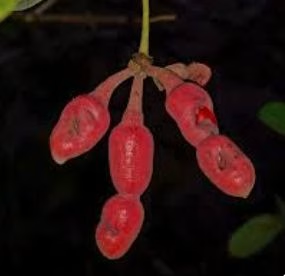
Fruits such as nyii, shumha, tsubvu, magwingwiziri, and mauyu (baobab) are not merely traditional foods.
They are economic assets waiting to be transformed into industries thorough value addition and preservation.
For too long, many rural communities have consumed these fruits seasonally and allowed the surplus to rot on the ground.
At the same time, Zimbabwe continues importing expensive processed foods, juices, cosmetics, snacks, and nutritional supplements that could partly be produced locally.
This contradiction reveals a painful truth: poverty is not always caused by lack of resources, but often by lack of systems, organisation, and value addition.
If strategically harnessed, Buhera and many other dry regions can convert God-given natural abundance into sustainable rural wealth.
God’s Providence Hidden in Indigenous Resources
Throughout the epochs of history, communities survived by understanding the value of their environment.
In biblical and African traditional contexts alike, land, trees, water, and livestock were viewed as provisions entrusted to people for stewardship and survival.
Today, many indigenous fruits growing naturally in rural Zimbabwe are exceptionally resilient to climate change.
While maize fields may fail during droughts, baobab trees continue producing fruit.
Wild fruits survive harsh temperatures that destroy imported crop varieties.
This resilience itself is an economic advantage.
Business people and authorities should take this advantage into bettering the lives of people in those areas who are butchered by severity of climate induced starvation.
The global market is increasingly shifting toward organic, natural, traditional, and climate-smart products.
Ironically, rural African communities already possess many of these products naturally, yet often export them raw or fail to commercialise them entirely.
Baobab powder, for example, is now sold internationally as a “superfood” because of its high Vitamin C, calcium, fiber, and antioxidant content.
Yet many rural households still see mauyu simply as a seasonal snack rather than a potential export commodity.
This is where mindset transformation becomes critical.
Moving from Consumption to Industrial Thinking
The major difference between poor and economically advanced agricultural regions is not always production quantity. It is processing capacity.
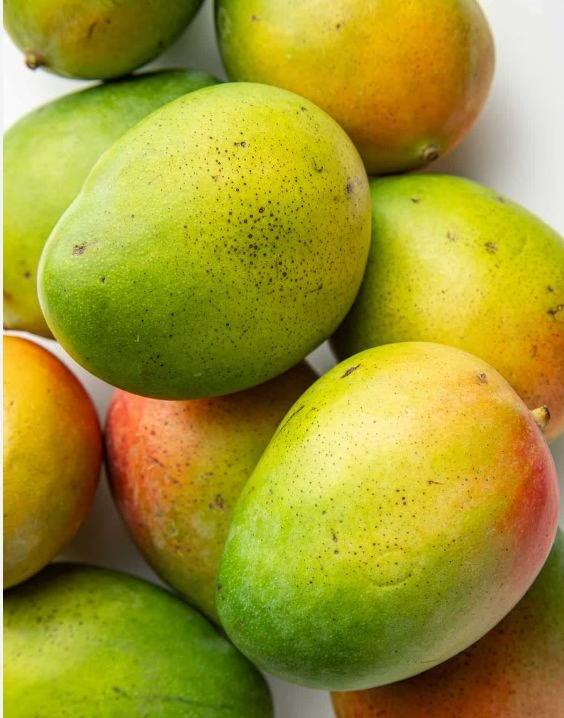
A mango sold raw at a roadside market may generate a small once-off income.
However, the same mango converted into dried fruit strips, juice concentrate, jam, chutney, or pulp can multiply its value several times over.
The proposed Buhera fruit model demonstrates how every fruit can generate multiple streams of income through value addition.
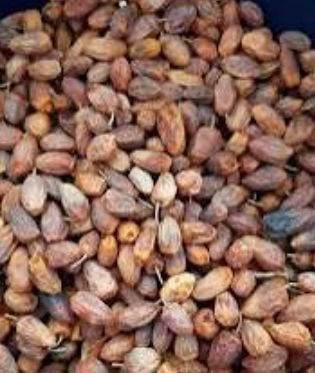
Nyii and shumha can be dried and milled into flour for porridge blends and healthy snacks.
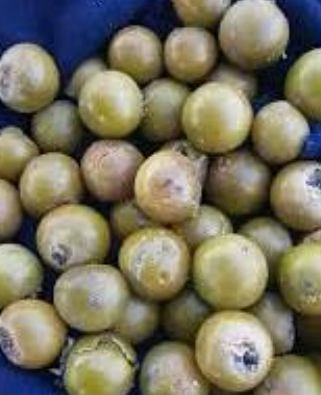
Tsubvu can become fruit paste, beverages, or even craft beverages for specialised markets.
Magwingwiziri can produce syrups, jellies, and food colorants.
Baobab can generate nutritional powders and cosmetic oils.
Instead of selling nature cheaply, communities begin selling finished products.
That is where real wealth begins.
Rural Industrialisation Without Heavy Factories
One of the greatest misconceptions in Africa is that industrialisation must always begin with billion-dollar factories.
In reality, small decentralised processing systems can transform entire districts.
Simple technologies such as solar tunnel dryers, fruit pulpers, oil extractors, milling systems, and vacuum packaging units can already create rural industries.
This model is particularly suitable for drought-prone areas because it does not rely entirely on water-intensive agriculture.
Indigenous fruits naturally regenerate each season with minimal inputs.
Under this framework, communities can establish:
- Fruit aggregation centres
- Solar-powered drying facilities
- Community milling plants
- Juice and jam processing hubs
- Packaging and branding units
- Cold storage systems powered by solar mini-grids
Such projects create employment for women, youths, transporters, marketers, technicians, and farmers.
Instead of rural youths migrating endlessly to urban centres in search of survival, local industries begin creating jobs within communities themselves.
Creating Wealth from What Was Previously Waste
A strong economic system wastes nothing.
Under this model, even fruit residues become profitable.
Mango skins, baobab shells, and guava seeds can be processed into livestock feed supplements.
Organic waste can produce biogas energy for processing plants.
Seeds can produce cosmetic oils.
Fruit fiber can support nutritional products.
This circular economy approach reduces environmental waste while increasing profitability.
In many successful agricultural economies globally, profitability is achieved not only from primary products, but from by-products as well.
Buhera and similar districts can adopt the same principle.
Three Markets, One Rural Economy
The brilliance of the proposed model lies in its tiered market structure.
First, local communities benefit from affordable nutrition.
Fruit-enriched porridge flour can support school feeding programs and clinics.
Low-cost cordials and juices improve household nutrition while supporting local cash circulation.
Second, urban markets provide higher profit margins.
Health-conscious consumers in cities increasingly seek natural products free from artificial preservatives.
Properly branded dried fruits, jams, and indigenous snacks can compete in supermarkets and boutique stores.
Third, export markets unlock foreign currency earnings.
International demand for baobab powder, indigenous foods, and natural cosmetic oils continues growing rapidly.
Diaspora communities across Asia, Europe, and North America often seek traditional African foods connected to identity and heritage.
This means a single baobab tree in Buhera can potentially connect a rural household to international markets.
Why This Model Matters for Zimbabwe
Zimbabwe has long depended heavily on raw commodity exports.
Yet countries that industrialise agricultural products capture far more economic value.
Instead of exporting raw fruits cheaply and importing expensive finished goods, communities can retain wealth locally through processing and branding.
This model also aligns strongly with climate adaptation goals.
Indigenous fruits are naturally suited to dry ecological regions where conventional agriculture struggles.
As climate shocks intensify, resilient local food systems become increasingly important.
Furthermore, the model promotes community ownership.
Cooperatives, churches, youth groups, women’s associations, and local entrepreneurs can all participate in various stages of the value chain.
This democratizes economic participation instead of concentrating wealth in a few hands.
The Role of Churches, Schools, and Local Leadership
For this vision to succeed, local leadership structures must move beyond dependency thinking.
Churches can help communities shift from survival mentality toward stewardship and productivity.
Schools and colleges can teach agro-processing, entrepreneurship, packaging, and food science.
Rural district councils can support infrastructure development and licensing processes.
Traditional leaders can help organise sustainable harvesting systems that protect indigenous trees from destruction.
Development partners and government agencies can assist with certifications, export compliance and machinery financing.
Poverty reduction becomes more sustainable when communities themselves participate actively in production rather than relying solely on aid.
Challenges That Must Be Addressed
Despite its promise, the model still faces real challenges.
Poor road networks increase transport costs.
Access to affordable machinery remains limited.
Many rural entrepreneurs lack packaging skills, branding knowledge, and export certification experience.
Electricity instability affects cold-chain systems.
There is also a need for stronger financial literacy and cooperative governance structures to prevent mismanagement.
However, these challenges are not impossible barriers.
They are development gaps requiring coordinated planning.
Many successful agro-industries around the world began at small community level before expanding gradually.
A New Vision for Rural Zimbabwe
Buhera represents more than one district.
It symbolises the untapped economic potential hidden across rural Zimbabwe.
Many dry regions possess indigenous resources capable of supporting agro-industrial ecosystems.
The future of rural development may not lie solely in importing foreign models, but in scientifically upgrading what communities already possess naturally.
God’s providence has already placed wealth within the land.
The challenge now is whether communities can organise, innovate, process, preserve, and market those resources effectively.
If properly implemented, indigenous fruit industrialisation can help transform rural districts from zones of seasonal hunger into centres of production, nutrition, exports, and economic dignity.