

One of the oldest questions in human history was asked by Cain after he had killed his brother Abel. He asked God, “Am I my brother’s keeper?” (Genesis 4:9). Thousands of years later, humanity continues to wrestle with the same question.
My answer is yes.
Whether one is Christian, Muslim, African Traditional Religion (ATR), Hindu, Buddhist, Jewish, or subscribes to no religion at all, the evidence from both faith and social science points in the same direction: societies flourish when people care for one another and decline when selfishness becomes the dominant value.
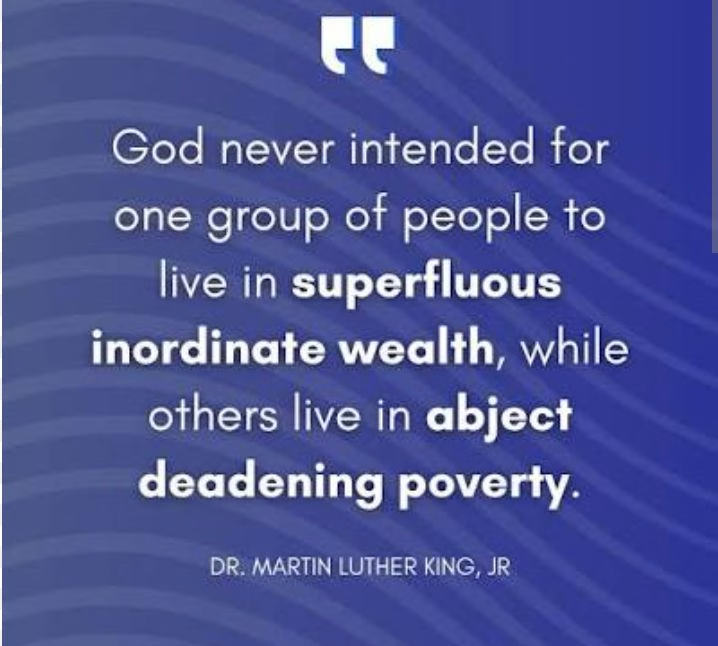
Poverty, exclusion, hunger, and suffering are not merely economic issues. They are also relational issues. They emerge and persist when communities stop seeing one another as brothers and sisters.
The Bible repeatedly teaches that caring for the poor is not an optional act of charity but a fundamental responsibility.
Communities with strong social support networks tend to experience lower levels of poverty, better health outcomes, greater resilience during crises, and stronger economic growth.
The Biblical Foundation of Social Responsibility
The teachings of Jesus place practical compassion at the center of genuine faith. In Matthew 25:35-36, Christ says:
“For I was an hungred, and ye gave me meat: I was thirsty, and ye gave me drink: I was a stranger, and ye took me in: Naked, and ye clothed me: I was sick, and ye visited me: I was in prison, and ye came unto me.”
This passage is remarkable because Jesus identifies himself with society’s most vulnerable members. Feeding the hungry, clothing the naked, and helping the marginalised are presented as acts of service to God Himself.
The prophet Isaiah reinforces this message:
“Learn to do well; seek judgment, relieve the oppressed, judge the fatherless, plead for the widow.” (Isaiah 1:17)
Here, justice is not merely a legal concept. It is active intervention on behalf of those who cannot adequately defend themselves.
The Bible repeatedly challenges believers to move beyond sympathy and toward practical action.
Psalm 82:3 similarly commands:
“Defend the poor and fatherless: do justice to the afflicted and needy.”
In all these texts, poverty is not treated as an unfortunate but unavoidable condition to be ignored. Rather, society is instructed to actively confront it.
Poverty Is More Than a Lack of Money
Social scientists increasingly understand poverty as multidimensional. It involves not only income shortages but also limited access to education, healthcare, opportunities, information, social networks, and decision-making power.
People often escape poverty not merely because they receive money but because they gain access to relationships, skills, mentorship, emotional support, and opportunities.
This is where Proverbs 31:8-9 becomes highly relevant:
“Open thy mouth for the dumb in the cause of all such as are appointed to destruction. Open thy mouth, judge righteously, and plead the cause of the poor and needy.”
Many poor people are not poor because they lack intelligence or work ethic.
They are poor because they lack representation, advocacy, and access.
Speaking for the voiceless can be just as important as giving financial assistance.
Modern development studies consistently show that empowering marginalised groups leads to stronger economic growth, reduced inequality, and improved social cohesion.
Generosity as an Economic Investment
Many people view helping others as a financial loss.
Deuteronomy 15:11 declares:
“For the poor shall never cease out of the land: therefore I command thee, saying, Thou shalt open thine hand wide unto thy brother, to thy poor, and to thy needy, in thy land.”
The verse acknowledges a difficult reality: poverty will always exist in some form. Yet it rejects indifference as a response. Instead, it commands generosity.
Proverbs 19:17 goes even further:
“He that hath pity upon the poor lendeth unto the Lord; and that which he hath given will he pay him again.”
Investments in human welfare often generate long-term returns for entire communities.
Helping a child stay in school, supporting a struggling family, mentoring a young entrepreneur, or assisting someone through illness often prevents larger social and economic problems in the future.
Economists describe such interventions as investments in human capital.
When people are empowered, they become productive contributors to society rather than remaining trapped in cycles of dependency.
The Importance of Open Hands
The Bible does not merely encourage occasional generosity. It encourages a culture of generosity.
Deuteronomy 15:7-8 instructs:
“If there be among you a poor man of one of thy brethren within any of thy gates in thy land which the Lord thy God giveth thee, thou shalt not harden thine heart, nor shut thine hand from thy poor brother: But thou shalt open thine hand wide unto him.”
The command addresses both the heart and the hand.
Poverty cannot be addressed merely through policy. It also requires empathy.
Research on social capital demonstrates that communities with strong traditions of mutual assistance tend to recover faster from economic shocks.
When neighbors support one another, when families share resources, and when communities cooperate, vulnerability decreases significantly.
This principle has been evident throughout African history.
Traditional communal systems often ensured that widows, orphans, and vulnerable families received support from the wider community.
Such values helped communities survive droughts, conflicts, and economic hardship long before modern welfare systems existed.
The Power of Cheerful Giving
The Apostle Paul writes in 2 Corinthians 9:7:
“Every man according as he purposeth in his heart, so let him give; not grudgingly, or of necessity: for God loveth a cheerful giver.”
The emphasis here is not merely on giving but on the spirit in which it is done.
Social psychology supports this idea.
Studies consistently show that acts of generosity improve emotional well-being, increase life satisfaction, strengthen social bonds, and enhance community trust.
People who help others often experience greater psychological health than those who focus exclusively on themselves.
Giving is therefore not only beneficial to the recipient but also transformative for the giver.
Faith Must Produce Action
One of the strongest biblical statements on poverty appears in James 2:14-17.
The apostle asks what good it is to tell hungry people to be warm and filled while refusing to provide what they need. He concludes:
“Even so faith, if it hath not works, is dead, being alone.”
This principle extends beyond religion. Every philosophy that values human dignity must eventually be expressed through action.
Good intentions alone cannot feed children. Speeches alone cannot create jobs. Sympathy alone cannot build schools, clinics, roads, irrigation systems, or businesses.
Ending poverty requires practical engagement.
Communities must move beyond discussing poverty and begin creating solutions through skills development, entrepreneurship, cooperative enterprises, local investment, agricultural productivity, education, and social protection.
A Universal Value Across Spiritual Traditions
While the Bible provides powerful teachings on caring for the poor, the principle of helping others is not unique to Christianity.
African Traditional Religion emphasises communal responsibility and collective well-being. Islam teaches zakat and charitable giving. Buddhism encourages compassion toward all beings. Hindu traditions promote selfless service. Secular humanists advocate human dignity and social justice.
Despite theological differences, many spiritual and ethical systems arrive at the same conclusion: human beings are interconnected.
Poverty cannot be solved by isolated individuals acting alone. It requires cooperation across families, communities, faiths, institutions, businesses, and governments.
The poor are not “other people.” They are members of our shared human family.
Building a Society Where Everyone Can Thrive
Jesus declared in Luke 6:20-21:
“Blessed be ye poor: for yours is the kingdom of God. Blessed are ye that hunger now: for ye shall be filled.”
This was not a celebration of poverty. Rather, it was a declaration of hope and dignity for those who suffer.
A society that genuinely values human dignity cannot be comfortable while millions remain hungry, unemployed, excluded, or marginalised.
The challenge is not simply to give handouts but to create pathways out of poverty through opportunity, empowerment, education, and inclusion.
Being our brother’s keeper means seeing another person’s struggle as partly our concern.
It means recognising that no community can achieve lasting prosperity while leaving large portions of its population behind.
The biblical message and the findings of social science converge on a profound truth: when people help one another, societies become stronger, healthier, safer, and more prosperous.
The question is no longer whether we are our brother’s keeper.
The question is whether we are willing to act like it.