

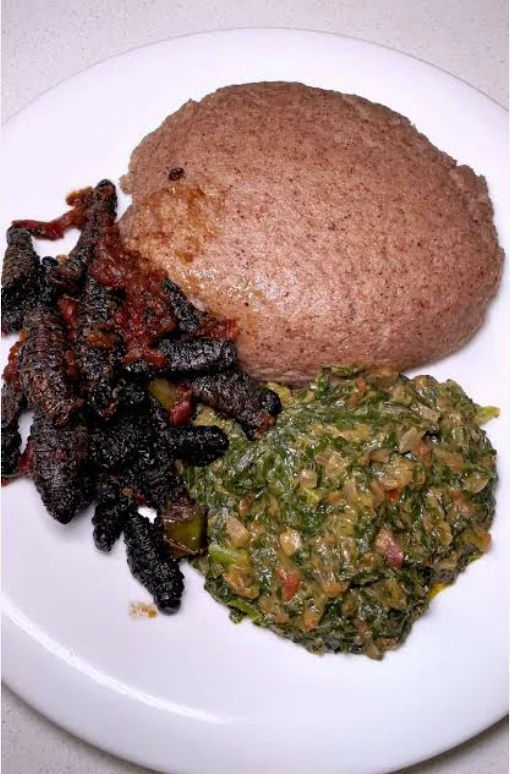
When Culture Becomes Policy
Zimbabwe’s recent embrace of gastronomy as a development pathway reflects a familiar pattern in its policy imagination: when conventional economic levers falter, culture is summoned as both remedy and narrative.
The Amai’s Traditional Cookout Competition has emerged as a central instrument in this shift, positioned not merely as a culinary celebration but as a symbol of national renewal, grassroots empowerment and tourism diversification.
Its growing presence alongside flagship platforms such as the Zimbabwe International Trade Fair signals a deliberate elevation.
Food is no longer confined to the domestic sphere; it is staged, curated, and deployed as an economic signal.
Yet the critical question persists: has Zimbabwe transformed gastronomy into an industry, or merely into an event?
Historical Trajectory: From Communal Fire to National Stage
The origins of the cookout in the early 2020s were modest, grounded in community traditions and the everyday practices of rural kitchens.
These early iterations represented what Ngũgĩ wa Thiong’o might describe as a recentring of indigenous knowledge, where food functions as both archive and identity.
By 2023, the initiative had expanded into provincial competitions, drawing widespread participation and media attention.
Coverage from ZBC News framed the events as a grassroots mobilisation of heritage, while The Herald increasingly linked them to narratives of economic revival.
Between 2024 and 2026, the cookout became embedded within the national events calendar, often staged alongside or in proximity to the Zimbabwe International Trade Fair and tourism showcases around Victoria Falls.
This transition, from community gathering to policy instrument—reveals a deliberate attempt to convert heritage into strategy.
But rapid elevation, in the Zimbabwean context, often outpaces structural grounding.
The Narrative of Success: Cultural Capital in Motion
The dominant narrative surrounding the cookout is one of success.
Indigenous foods once marginalised are now celebrated, repositioned as markers of identity and pride.
This reflects what Pierre Bourdieu conceptualises as the accumulation of cultural capital—the revaluation of practices previously considered peripheral.
State-aligned media frequently asserts that traditional cuisine is “powering economic growth,” and highlights stories of inclusion and empowerment.
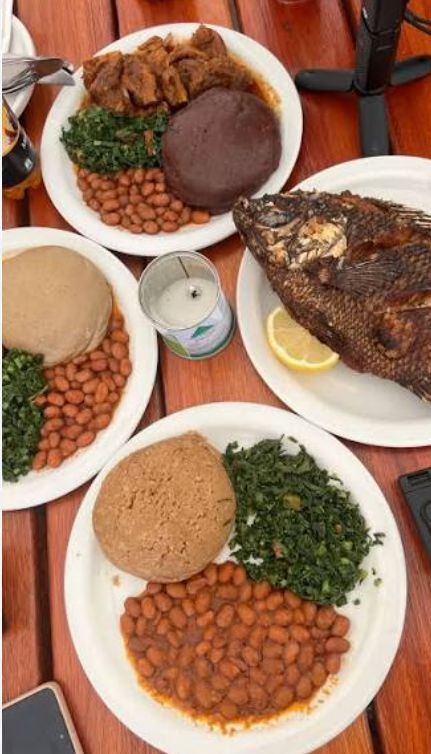
The cookout is presented as a bridge between past and future, culture and commerce.
There is substance to this claim.
The initiative has succeeded in mobilising participation, restoring dignity to indigenous food systems, and inserting gastronomy into national discourse.
It aligns with global trends identified by the UN World Tourism Organisation (UNWTO), where food is increasingly central to tourism experiences.
Yet, as Bourdieu reminds us, cultural capital must be converted. Recognition alone does not generate income.
Ground Realities: The Limits of Conversion
Beyond the spectacle of the event, structural constraints persist.
Participants operate within an economic environment marked by informality, limited access to finance, and inadequate infrastructure.
Recognition at the cookout rarely translates into sustained enterprise development.
Even within largely optimistic coverage, there are subtle acknowledgements—occasionally echoed in private media outlets that exposure does not guarantee market access.
This reveals a fundamental disconnect: the cookout generates visibility without continuity.
From the perspective of Amartya Sen, development must expand real capabilities—the ability to access markets, resources, and opportunities.
Participation, while important, is insufficient.
In its current form, the cookout expands symbolic participation more than it expands economic capability.
The result is a cycle where individuals are celebrated at the event but remain constrained in the aftermath.
Gastronomy and Tourism: Visibility Without Depth
Zimbabwe’s tourism sector has increasingly incorporated gastronomy into its branding, particularly in destinations such as Victoria Falls.
Food is now part of the national tourism narrative, reflecting global insights from the UN World Tourism Organisation that cuisine shapes travel decisions.
There is evidence of increased visibility.
Tourists encounter traditional dishes more frequently, and culinary elements are now integrated into promotional material.
However, this transformation remains surface-level.
Structured gastronomic experiences—fine dining rooted in local cuisine, curated food tours, and consistent quality standards—are limited.
As Dean MacCannell argues, tourism depends on “staged authenticity.”
Zimbabwe possesses authenticity in abundance, but its staging remains episodic, often tied to events rather than embedded in everyday tourism infrastructure.
The result is a tourism offering that is promising but underdeveloped, capable of attracting curiosity but not yet commanding premium value.
Comparative Perspective: Systems Beyond Spectacle
A comparison with countries such as South Africa, Thailand, and Italy highlights a critical distinction.
In these contexts, gastronomy is embedded within systems—value chains, regulatory frameworks, and global branding strategies.
Thailand’s culinary diplomacy, Italy’s protected food heritage systems, and South Africa’s integration of gastronomy into export industries all demonstrate that food becomes economically transformative only when supported by institutional depth.
Zimbabwe, by contrast, remains largely event-driven.
The cookout showcases potential but does not yet anchor a fully functional industry.
This gap reflects what Dani Rodrik describes as the absence of productive transformation, where economies struggle to move from low-value activities to high-value sectors.
Structural Constraints: The Unresolved Foundations
The limitations of the cookout are inseparable from Zimbabwe’s broader economic environment.
Reports from institutions such as the World Bank consistently highlight challenges in infrastructure, informality, and investment.
These constraints directly affect gastronomy’s scalability.
Without reliable energy, transport systems, and access to finance, culinary enterprises remain fragile.
As Ha-Joon Chang argues, development requires institutional scaffolding.
Cultural initiatives can catalyse interest, but they cannot substitute for the systems needed to sustain growth.
Towards a Systemic Shift: From Event to Ecosystem
For the cookout to evolve into a genuine economic driver, it must transition from event-based visibility to system-based sustainability.
This requires integrating participants into continuous value chains, formalising enterprises, and investing in infrastructure.
Platforms such as the Zimbabwe International Trade Fair should function not as endpoints of exposure but as gateways to markets and investment.
Equally critical is the need for empirical evidence.
Without data—tracking business survival rates, income growth, and employment creation—policy risks being guided by narrative rather than measurable outcomes.
From Symbolic Fire to Structural Flame
The Amai’s Traditional Cookout Competition has, without question, altered Zimbabwe’s cultural and policy landscape.
It has restored dignity to indigenous cuisine, repositioned food as heritage, and inserted gastronomy into national development discourse.
In doing so, it has achieved what many policy interventions fail to do—it has mobilised people, memory, and meaning.
But mobilisation is not transformation.
What emerges from a synthesis of both the optimistic narrative and the grounded critique is a more sober reality: the cookout is neither a hollow spectacle nor a fully realised economic engine.
It occupies an uncomfortable but revealing middle ground—a culturally successful initiative with incomplete economic translation.
State narratives, amplified through their media emphasise empowerment, tourism growth, and national pride.
Meanwhile, quieter acknowledgements sometimes reflected in private media point to structural gaps: limited post-event support, fragile market linkages, and the persistence of informality.
Both perspectives are valid; neither is sufficient on its own.
In theoretical terms, Zimbabwe has succeeded in generating cultural capital, but has yet to consistently convert it into economic capital.
The cookout has mastered the language of identity and visibility, yet it still struggles with the grammar of systems—value chains, infrastructure, standardisation, and scale.
This is the distance between firewood and foreign currency.
As Frantz Fanon cautioned, national culture cannot remain at the level of folklore; it must be materially embedded.
Similarly, the cookout cannot remain an annual crescendo of activity followed by economic silence.
It must evolve into a continuous, structured ecosystem where participants are not only celebrated but economically sustained.
The path forward is neither to dismiss the initiative nor to romanticise it.
It is to discipline it with structure—to move from events to industries, from participation to production, from narrative to measurable outcomes.
Platforms like the Zimbabwe International Trade Fair should not merely display culinary potential; they should connect it to enduring markets and investment pipelines.
Zimbabwe has already proven that it can tell a compelling story about its food.
The unresolved task is harder: to build the institutional and economic architecture that ensures this story feeds livelihoods, not just pride.
Until that transition is made, the cookout will remain what it currently is—
a powerful cultural symbol, a persuasive national narrative, and an unfinished economic project still searching for structural fire.