

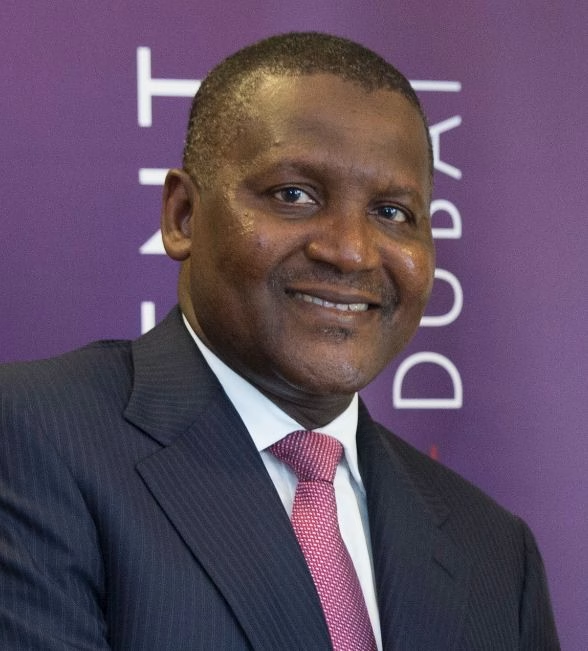
The Forbes Africa’s richest people 2026 list shows strong growth, with 23 billionaires now worth a combined $126.7 billion.
Markets have rallied, currencies have stabilised, and fortunes have expanded across key sectors.
At the top sits Aliko Dangote, followed by Johann Rupert and Nicky Oppenheimer.
Yet one detail reshapes the narrative.
Only one billionaire—Mohammed Dewji is aged 50, while the rest are over 60.
This detail defines the Africa’s richest people 2026 conversation and exposes a deeper structural pattern.
Wealth Takes Time in Africa
The Africa’s richest people 2026 ranking highlights a key truth: wealth on the continent takes time to build.
African billionaires dominate industries such as cement, mining, telecoms, and energy, and these sectors demand patience, scale, and long-term investment.
Entrepreneurs operate within complex systems, and they navigate currency instability, policy shifts, and capital constraints over many years.
As a result, wealth matures slowly.
It rewards endurance, and it reflects decades of survival and expansion.
Self-Made, But Not Fast-Made
Another key insight from Africa’s richest people 2026 is that 14 of the 23 billionaires are self-made.
This suggests opportunity, yet the reality remains layered.
In Africa, self-made wealth develops within structured environments.
Entrepreneurs must access networks, secure licenses, and build within industries that resist quick entry.
Therefore, success does not come quickly.
Instead, it grows through long-term positioning and sustained engagement.
This explains why the African billionaires age trend leans heavily toward older individuals.
A Young Continent Locked Out of Big Wealth
The Africa’s richest people 2026 list contrasts sharply with the continent’s youthful population.
Africa remains the youngest region globally, yet its wealth sits with an older generation.
Young Africans drive innovation, particularly in fintech and digital sectors, but they struggle to scale into billion-dollar enterprises.
Limited access to funding, infrastructure gaps, and restricted economic entry points slow their progress.
As a result, the Africa wealth age gap continues to widen.
The Youngest Billionaire in Africa
Mohammed Dewji remains the youngest billionaire in Africa at 50, according to Africa’s richest people 2026.
His position highlights the broader pattern rather than breaking it.
His wealth is rooted in established business structures, and it reflects long-term investment across multiple sectors.
Therefore, even the youngest billionaire Africa fits within a system defined by time and continuity.
Global Comparison: Young Billionaires vs African Wealth
Globally, wealth creation follows a different path.
Figures such as Alexandr Wang have reached billionaire status in their twenties, driven by fast-scaling technology ventures.
This contrast sharpens the Africa wealth age gap discussion.
While global billionaires scale through digital platforms, African billionaires build through infrastructure and long-term capital investment.
One system rewards speed, while the other rewards survival.
An Economy That Ages Its Wealth
The Africa’s richest people 2026 ranking shows how economic structures shape outcomes.
Older elites maintain control over capital and networks, and younger entrepreneurs operate with limited access to large-scale opportunities.
This dynamic delays wealth creation among younger generations, and it reinforces the dominance of older billionaires.
Over time, this pattern defines the structure of African capitalism.
The Generational Risk in Africa’s Wealth Structure
The Africa wealth age gap presents a growing challenge.
A young population continues to innovate, yet economic power remains concentrated among older individuals.
This imbalance risks slowing economic mobility and increasing generational inequality.
However, emerging sectors such as technology and fintech could reshape the landscape if they enable faster access to capital and scale.
Africa’s Richest People 2026: Show Wealth Takes Time
The Africa’s richest people 2026 list reveals more than rising fortunes.
It shows how wealth behaves across the continent.
In Africa, wealth builds slowly, systems reward patience, and capital accumulates over decades.
As a result, billionaires emerge later in life.
The conclusion remains clear. Wealth in Africa does not move quickly. It waits, and in that waiting, it grows older.