

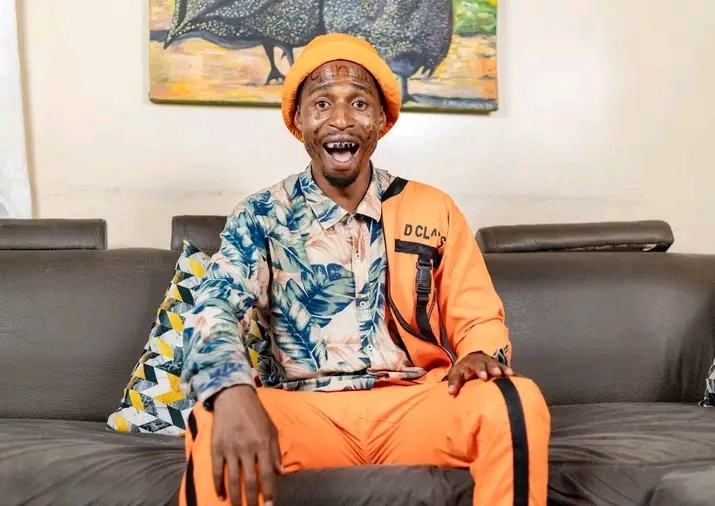
In Zimbabwe’s fragile socio-economic landscape, where unemployment, informality, and digital improvisation increasingly define everyday survival, the emergence of Ronald Chimombe’s “Thuga Thuga” persona represents more than a shift in entertainment.
It represents a transformation in how identity is constructed, how visibility is achieved, and how cultural meaning is circulated in the digital age.
What appears on the surface as comedic performance is, on closer reading, a layered cultural text shaped by algorithmic logic, social memory, and performative reinvention.
Chimombe’s transformation is particularly striking because it marks a shift from institutional identity to digital identity.
Once associated with the structured authority of policing, he now operates within the fluid and unpredictable economy of social media performance.
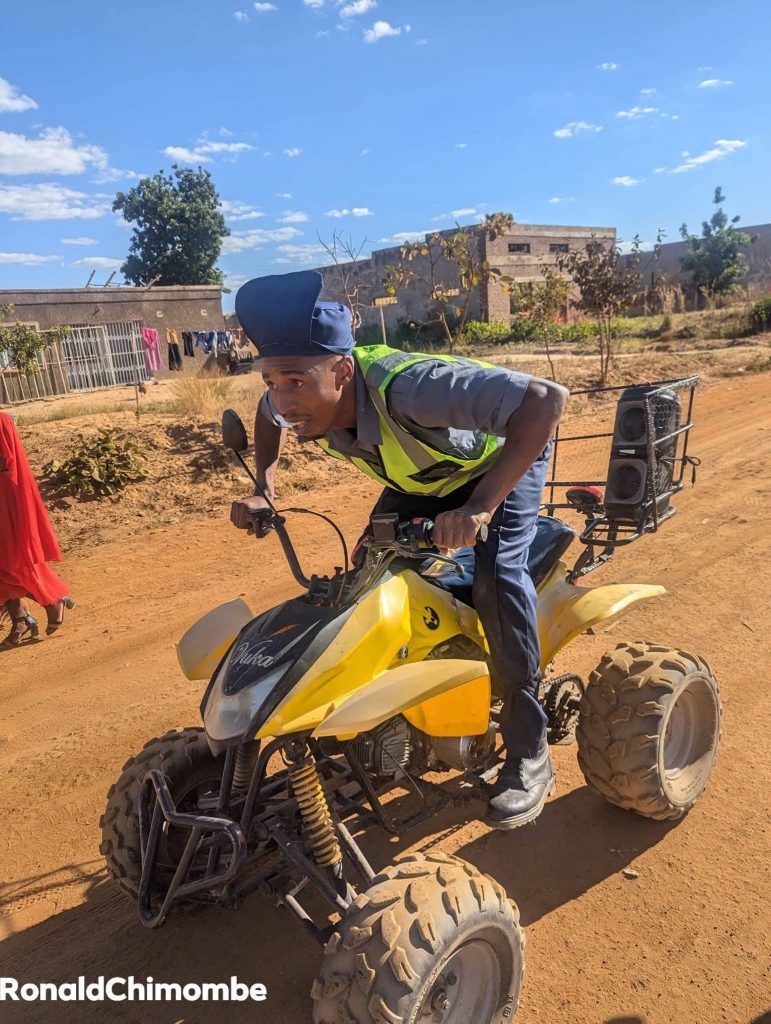
Ironically, he appears more visible and culturally resonant in his fictional persona than in his former institutional role.
This is not merely personal reinvention; it reflects a broader cultural shift from state-centred legitimacy to algorithm-driven relevance, where recognition is no longer granted by institutions but produced through circulation, engagement, and repetition.
The question, therefore, is not whether “Thuga Thuga” is problematic, but what it reveals about contemporary society and what it offers as a cultural and analytical object.
Public criticism has often focused on the presence of guns, staged violence, and exaggerated masculine gestures within the skits, particularly the now-iconic “clap” that has become central to the character’s identity.
These concerns are understandable in a society where lived experiences of violence remain part of the social fabric.
However, analytically, such critiques risk collapsing representation into endorsement.
Across global media systems, stylised violence is a familiar aesthetic device.
Productions such as John Wick and Rush Hour rely heavily on choreographed violence, yet audiences interpret them as fiction rather than instruction.
Chimombe’s work operates within this same symbolic grammar, but with a crucial difference: it translates violence into localised satire, where humour and exaggeration become interpretive filters.
In this context, the gun functions as a prop rather than an instrument, and aggression operates as exaggeration rather than behavioural guidance.
The deeper artistic question is not whether violence is present, but how it is staged, signified, and ultimately understood within its cultural frame.
At the centre of this performance is the body itself.
The signature “clap” is not simply a comedic gesture but a structured semiotic device that communicates authority, rhythm, and identity simultaneously.
It functions as a command signal, a comedic punctuation mark, and a branding mechanism that anchors recognition across platforms.
This form of embodied meaning illustrates how digital performance often transcends language, relying instead on gesture as a primary carrier of cultural significance.
Importantly, this gesture also reveals continuity rather than rupture.
Chimombe’s bodily performance carries echoes of institutional discipline, suggesting that authority is not discarded but reconfigured in symbolic form.
What emerges is not a break from the past, but an adaptation of its memory into a new cultural medium.
Understanding Chimombe’s success also requires attention to the political economy of attention that governs digital platforms.
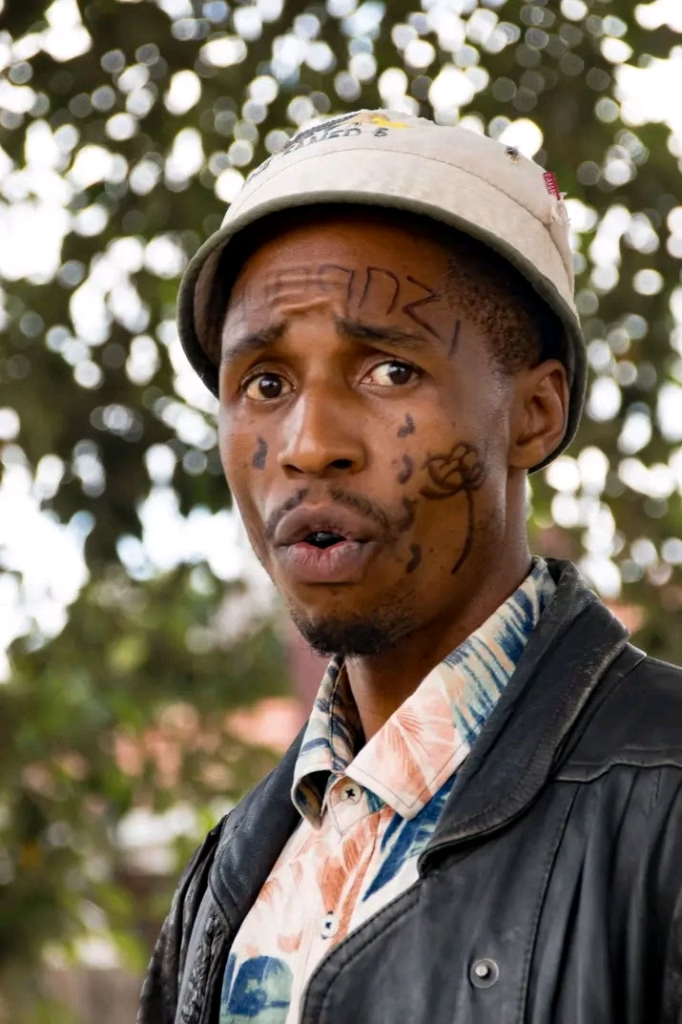
Social media systems reward intensity, repetition, emotional immediacy, and recognisable symbolic markers.
Within this structure, the “clap,” triumphant laugh, exaggerated expressions, and rapid tonal shifts are not incidental artistic choices but structurally efficient signals that increase visibility and circulation.
In this sense, Chimombe is not only performing for audiences but also for algorithmic systems that convert visibility into economic opportunity.
This marks a broader shift in contemporary culture where performance is no longer solely expressive but also strategically aligned with platform logic.
The gestures of command, discipline, and controlled aggression present in “Thuga Thuga” suggest that institutional power does not disappear when individuals exit formal structures.
Instead, it is reassembled within cultural performance.
The result is a form of re-staged authority that is both familiar and destabilised.
For audiences, particularly those accustomed to hierarchical forms of power, this creates a paradox in which authority is simultaneously recognised, mimicked, and ridiculed.
The performance thus becomes a site where state memory intersects with street imagination.
Language also plays a central role in Chimombe’s artistry.
His multilingual fluidity is not simply decorative but structurally significant.
Through code-switching, he expands audience reach, enhances comedic timing, and reflects the hybrid linguistic realities of contemporary Zimbabwean life.
Language here becomes more than communication; it becomes cultural infrastructure, shaping rhythm, identity, and accessibility simultaneously.
This linguistic flexibility transforms everyday speech into a performative asset, demonstrating that cultural expression is deeply embedded in the way language is lived, not just spoken.
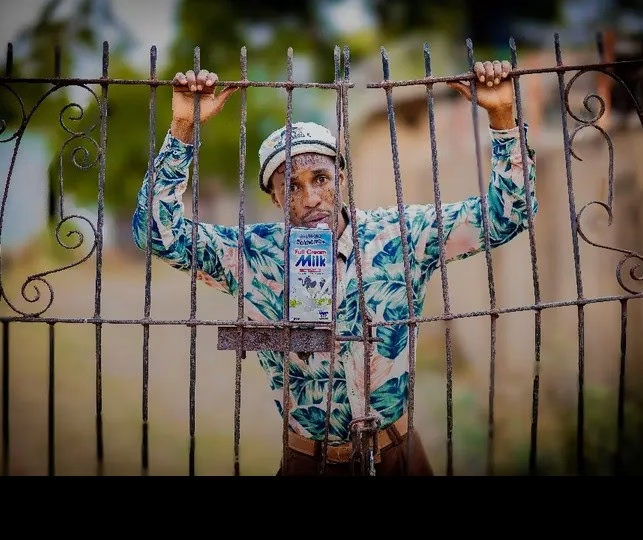
These visual markers are not accidental ornamentation; they are part of a globalised aesthetic language of street masculinity that circulates heavily through South African popular culture, music videos, and social media iconography.
Within this visual economy, tattoos, aggressive styling, and curated “danger aesthetics” function as symbolic shorthand for toughness, survival, and credibility.
Chimombe’s adoption and exaggeration of these cues places him within a transnational visual register where identity is not only spoken or acted, but worn.
However, his performance simultaneously destabilises this imagery through comedic framing, preventing it from settling into a fixed identity category.
What emerges is a tension between the appearance of authenticity and the intent of satire, forcing audiences to constantly negotiate whether they are witnessing representation, parody, or both.
Another key dimension is the recurring but invisible character “Thabiso,” who never appears physically but remains central to the narrative structure.
This absent presence functions as an unseen authority, a psychological counterforce, and a narrative tension point. In storytelling theory, such devices amplify meaning by allowing absence to carry interpretive weight.
Psychologically, Thabiso can also be understood as a projection of internal tension or externalised authority, demonstrating that digital storytelling often relies on imagination and implication as much as visual representation.
The unseen becomes more powerful than the seen, revealing the sophistication of minimalist narrative construction.
The performance also engages with masculinity as a constructed and exaggerated identity.
“Thuga Thuga” embodies a form of masculinity shaped by dominance, emotional restraint, and control under pressure.
However, this is not a direct reflection of behaviour but a stylised exaggeration of social expectations around male identity.
It reflects how masculinity is often performed rather than lived in pure form, especially within comedic and theatrical contexts.
The public reaction to Chimombe’s content also reveals a deeper inconsistency in cultural interpretation.
Stylised violence in local productions is often criticised more intensely than similar representations in global cinema or institutional narratives.
This suggests that the debate is not solely about violence itself, but about cultural proximity, authorship, and perceived legitimacy.
What emerges is a form of selective moral interpretation in which similar content is judged differently depending on who produces it and in what context it appears.
While Chimombe’s work should not be reduced to economic explanation, it exists within a broader socio-economic environment where digital platforms have become spaces of visibility, experimentation, and informal income generation.
In such environments, creativity often becomes intensified by constraint, and cultural production increasingly occurs outside traditional institutional structures.
This context does not define the art, but it helps explain its urgency and resonance.
Ultimately, what “Thuga Thuga” reveals is not simply a character but a cultural condition.
It demonstrates how identity is performed rather than fixed, how authority is reassembled in digital spaces, and how language, gesture, and humour operate as interconnected systems of meaning.
It also highlights the importance of cultural literacy in interpreting digital performance beyond surface readings.
The central question is therefore not whether the content is too violent, but whether audiences are equipped to distinguish satire from instruction, performance from reality, and symbolism from endorsement.
Because in the evolving landscape of digital culture, meaning is no longer only produced by creators—it is completed by interpretation.
And in that space between performance and perception lies the true significance of “Thuga Thuga.”