

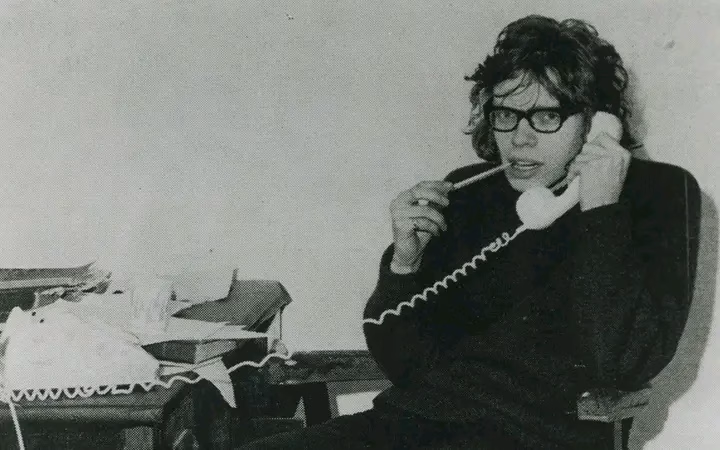
British billionaire entrepreneur Richard Branson has revisited the origins of his first business, describing how he launched a youth culture magazine at just 16 years old with no funding, no office, and no established network.
In a Facebook post, Branson reflected on the uncertainty of those early days, writing: “When I was 16, I built a business from inside a phone box.”
He added that at the time, “We did not have computers, the internet or smartphones.
I also did not have a network. I did not have funding.
And to be honest, I did not have a clue what I was doing!”
The idea behind the venture was to create a youth-focused magazine that could help young people better understand current affairs and provide space for conversations often avoided in mainstream media.
Branson said it was intended as “a safe place to learn about topics no-one talked about at the time—like abortion or finding community as a gay person.”
However, the project quickly ran into structural challenges.
“The problem was, no one knew who we were. We had no advertisers, no office, no contributors and certainly no credibility,” he wrote.
With limited resources, Branson turned to direct outreach using a phone book.
“At a bit of a loss, I decided to open the phone book and started calling people,” he explained, adding that he contacted companies and asked to speak to those responsible for advertising.
Branson admitted that persuasion played a key role in those early pitches.
“When they answered, I would do my best to sound far more experienced than I was,” Branson, described how he positioned the magazine with statements such as: “Are you interested in reaching the most influential young people in Britain?” and “Your competitors are already advertising with us.”
Despite repeated rejection, persistence eventually began to pay off.
“Call by call, rejection by rejection, something started to happen. A few people said yes. Then a few more,” he noted. “I could hardly believe it.”
Those early advertising commitments enabled the production of the magazine’s first issue.
“Eventually, we had enough advertisers to print the first issue,” Branson said.
The publication, later known as Student, went on to feature interviews with major cultural figures including Mick Jagger and John Lennon, marking a breakthrough moment for the teenage entrepreneur.
Reflecting on the experience, Branson said it shaped his lifelong business philosophy.
“That scrappy little magazine went on to interview people like Mick Jagger and John Lennon,” he wrote, adding that it taught him “one of the most valuable lessons of my life.”
He concluded, “You do not need everything figured out to get started. You just need a bit of tenacity, a lot of self-belief, and the drive to keep the promises you have made (especially when they are a little ambitious!).”
Branson later built the Virgin Group, which grew into a global brand spanning multiple industries, but he says the foundations were laid in those early, uncertain days inside a phone box.