

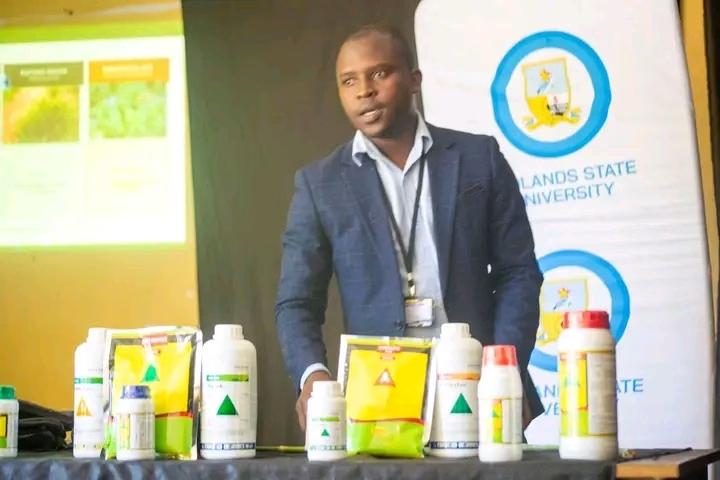
Midlands State University (MSU), in partnership with AGRITEX, has stepped up efforts to improve national wheat production through a high-level farmer training workshop held in on 28 April 2026.
The workshop, hosted by MSU’s Department of Agronomy and Horticulture under the Faculty of Agriculture, Environment and Natural Resources, brought together farmers, extension officers and researchers to exchange practical and scientific knowledge aimed at boosting yields and advancing Zimbabwe’s wheat self-sufficiency drive.
Opening the engagement, Gweru District Agricultural Extension Officer T. Mubaiwa said strengthening farmer capacity remains central to meeting national production targets.
“Workshops such as these are essential in equipping farmers with the skills and information they need to improve productivity, increase yields, and contribute meaningfully to the country’s food security goals,” he said.
MSU lecturers T. Madanzi, W. Mugobe and D. Dhlamini led the technical sessions, outlining critical agronomic practices across the wheat production cycle, from land preparation and planting to harvesting.
Their presentation emphasised the importance of disease, pest and weed management, as well as adherence to climate-specific production guidelines.
“High wheat yields begin with proper planning and adherence to recommended agronomic practices from planting up to harvesting, including a clear understanding of climate requirements and the effects of temperature,” Madanzi said.
Industry stakeholders also contributed to the discussions, with agronomists from Avgust Zimbabwe and Farmers Choice focusing on the responsible use of herbicides and crop chemicals to ensure both productivity and environmental sustainability.
Participants later engaged in an interactive plenary session, where farmers shared field experiences and sought clarification on technical challenges, highlighting the persistent gap between research outputs and on-the-ground agricultural practice.
Closing the workshop, Ekhaya Farm Director J.J. Dube commended the collaboration between academia, government extension services and private sector players, describing it as critical to transforming Zimbabwe’s agricultural sector.
The initiative forms part of MSU’s broader strategy to promote research-driven agriculture and contribute to national development priorities under the , while aligning with on ending hunger and achieving food security.